I wouldn't normally bother registering the fact that Army Painter have added a couple more colours, but I couldn't fail to be amused when I noticed that the two latest additions to their Warpaints range are...
Chaotic Red and Hydra Turquoise.
Or, to put it another way, murrey and blue. If you were paying attention in the Heraldry series of posts, you'd know why I'm amused. If not? They're very popular Wars of the Roses livery colours, and I have four boxes of Perry's to paint sometime after June :D
Usefully, they also do the red as a primer.
Showing posts with label heraldry. Show all posts
Showing posts with label heraldry. Show all posts
Tuesday, 13 May 2014


Saturday, 8 February 2014
Heraldry 101, summary post
As promised:
Heraldry 101, part 1 - introduction
Heraldry 101, part 2 - what colour is it?
Heraldry 101, part 3 - left, right, top, bottom and divisions
Heraldry 101, part 4 - ordinaries, and the Rule of Tincture
Heraldry 101, part 5 - charges, and arranging them
Heraldry 101, part 6 - Lions, Tigers (well, almost) and Bears, oh my!
Heraldry 101, part 7 - an aside, and answers
Heraldry 101, part 8 - strictly for the birds
Heraldry 101, part 9 - Fish Heads. Roly poly fish heads
Heraldry 101, part 10 - Crosses
Heraldry 101, part 11 - Marshalling Coats Of Arms
Heraldry 101, part 12 - Marks of Cadency
Heraldry 101, part 13 - 'patterned' backgrounds
Heraldry 101, part 14 - edges
Heraldry 101, part 15 - a broader palette
Heraldry 101, part 1 - introduction
Heraldry 101, part 2 - what colour is it?
Heraldry 101, part 3 - left, right, top, bottom and divisions
Heraldry 101, part 4 - ordinaries, and the Rule of Tincture
Heraldry 101, part 5 - charges, and arranging them
Heraldry 101, part 6 - Lions, Tigers (well, almost) and Bears, oh my!
Heraldry 101, part 7 - an aside, and answers
Heraldry 101, part 8 - strictly for the birds
Heraldry 101, part 9 - Fish Heads. Roly poly fish heads
Heraldry 101, part 10 - Crosses
Heraldry 101, part 11 - Marshalling Coats Of Arms
Heraldry 101, part 12 - Marks of Cadency
Heraldry 101, part 13 - 'patterned' backgrounds
Heraldry 101, part 14 - edges
Heraldry 101, part 15 - a broader palette
Tuesday, 28 January 2014
Heraldry 101 - part 15 - a broader palette
Let's go right back to part 2, shall we?
If you've been with this series since the start, you'll remember that I started out with the 'core' tinctures - colours, metals and furs - gules, sable, vert, azure, argent, or, ermine and vair.
Time for the rest!
The other common colour is purple, or purpure. Additional to that are a number of other colours, usually referred to as stains: the most common of these are:
- tenné - from an old French word from which we get, unsurprisingly, 'tawny', is a brownish orange shade
- murrey - a 'mulberry' shade, sort of reddish-purple
- sanguine - from an old French word meaning (obviously enough) blood red, is an orangey-red shade.
Stains are mostly only known in post-mediaeval heraldry, and often found in livery. For those who remember Robert Lewis Stevenson's "Black Arrow", set in the Wars of the Roses:
"The chief part were in Sir Daniel’s livery, murrey and blue, which gave the greater show to their array."
Murrey and blue seems to have been quite common as a livery - the Duke of Clarence and Richard of Gloucester (Richard III), among a number of Yorkist lords.
And then we come to the extra furs, which come in a bewildering array I'll just list with handy examples from Coat of Arms Design Studio.
And there you have it. Heraldry 101.
I hope you enjoyed this series - I'll stick up a handy index post in a couple of days so you can find things.
Respectfully dedicated to the memory of Arthur Whitaker, teacher, Methodist local preacher and my grandfather, without whom I'd not love a number of the things I do today, and whose much thumbed and loved copy of "Boutell's Heraldry " has been my, and thus your, guide through this series.
And then we come to the extra furs, which come in a bewildering array I'll just list with handy examples from Coat of Arms Design Studio.
 |
| Counter-Vair |
 |
| Ermines |
 |
| Erminois |
 |
| Pean |
 |
| Potent |
 |
| Counter-potent |
And there you have it. Heraldry 101.
I hope you enjoyed this series - I'll stick up a handy index post in a couple of days so you can find things.
Respectfully dedicated to the memory of Arthur Whitaker, teacher, Methodist local preacher and my grandfather, without whom I'd not love a number of the things I do today, and whose much thumbed and loved copy of "Boutell's Heraldry
" has been my, and thus your, guide through this series.Monday, 2 December 2013
Heraldry 101 part 14 - edges
So far, we're been as boring with the edges of things as we had with backgrounds until the previous article. Time for all that to change.
In the absence of anything to the contrary, the edge of a charge or ordinary, or a division of a field, is an appropriately straight or curved line. However, not all charges are edged that way.
A charge is said to be indented if its edge is made of even zig-zag lines. In normal circumstances, points on opposite sides face away from each other: if the peaks on one side match troughs on the other (so, for example, in the case of a fess making a broad zig-zag line) then the term is dancetty.
If the zig-zag is made up of curved, rather than straight, line segments, its said to be rayonné.
An edge that looks like a set of battlements is embattled - a square wave, if you like. If the battlements have multiple steps, it's battled embattled or embattled grady. If the upward edges go past the vertical, the term (which is obvious once you look at it) is dovetailed.
If we move from a 'square wave' edge to a sine wave, the term is wavy. If the waves go past the vertical (like dovetailed) the analogous term is nebuly. An edge that looks like breaking waves is wavy crested.
The other common line type is a series of circular arcs joined at their points (like the edge of a cookie cutter). If the points are outward, it's engrailed, inward, it's invected.
Once again, we've well exceeded the limit of what the free version of Coat of Arms Design Studio can handle, so I'm ducking out of drawing too many diagrams. There are a beautiful set of examples on the Wikipedia page, as well as a whole load of more obscure terms.
Note above, the arms of Berry: azure, three fleurs-de-lys or, a bordure engrailed gules. In this case, the bordure or border is a mark of cadency, as the dukedom was (rather like the Duchy of York in England) given to younger sons of the French king (azure, three fleurs-de-lys or being France).
In the absence of anything to the contrary, the edge of a charge or ordinary, or a division of a field, is an appropriately straight or curved line. However, not all charges are edged that way.
A charge is said to be indented if its edge is made of even zig-zag lines. In normal circumstances, points on opposite sides face away from each other: if the peaks on one side match troughs on the other (so, for example, in the case of a fess making a broad zig-zag line) then the term is dancetty.
.svg/545px-Blason_duche_fr_Berry_(moderne).svg.png) |
| The arms of Berry |
An edge that looks like a set of battlements is embattled - a square wave, if you like. If the battlements have multiple steps, it's battled embattled or embattled grady. If the upward edges go past the vertical, the term (which is obvious once you look at it) is dovetailed.
If we move from a 'square wave' edge to a sine wave, the term is wavy. If the waves go past the vertical (like dovetailed) the analogous term is nebuly. An edge that looks like breaking waves is wavy crested.
The other common line type is a series of circular arcs joined at their points (like the edge of a cookie cutter). If the points are outward, it's engrailed, inward, it's invected.
Once again, we've well exceeded the limit of what the free version of Coat of Arms Design Studio can handle, so I'm ducking out of drawing too many diagrams. There are a beautiful set of examples on the Wikipedia page, as well as a whole load of more obscure terms.
Note above, the arms of Berry: azure, three fleurs-de-lys or, a bordure engrailed gules. In this case, the bordure or border is a mark of cadency, as the dukedom was (rather like the Duchy of York in England) given to younger sons of the French king (azure, three fleurs-de-lys or being France).
Wednesday, 9 October 2013
Heraldry 101 part 13 - 'patterned' backgrounds
A short one, this: we have two more posts to go rafter this to complete the series, namely one on the edges of things, and one on a collection of little/entertaining things that didn't fit anywhere else.
So - backgrounds. You'll notice that almost all our backgrounds, with the exception of the furs, are single colours. It is, however, possible to have what are effectively patterned backgrounds.
One of the more common ones is a background strewn with charges of some sort. Most of the ordinaries can be used, for example a background can be bendy sable and or, which would be a field of alternate diagonal black and gold stripes.
Now at this point, the more astute among you are wondering, how do you tell the difference between (say) sable, three bends or, and bendy sable and or? Actually, it's pretty simple: if there are an even number of bands of alternating colour (i.e. the two extremes are not the same colour), it's a divided field, so bendy: if there are an odd number, i.e. the two extremes are the same colour, it's charges on a coloured field. Simples.
[As a slightly amused aside, the reason you're getting no diagrams for the above is that Coat of Arms Design Studio GETS IT WRONG for bendy!!!!]
You can do this with most of the common ordinaries and charges. Some of them have obvious names. Some, predictably, don't. Chevronny, barry, bendy and paly should be obvious, as I hope should chequey or checky (which we mentioned in passing in a previous post) and lozengy. Divisions of ordinaries are usually a colour and a metal, but can in rare cases be two of one or the other.
For charges, in the absence of a suitable collective noun, we say the field is semy or semé of the charge, for example argent, semé of roses gules. And again, there are more exceptions to this than not: a roundel or, as you may remember, is a beazant - semé of beazants is beazanté or beazanty (as you may have noticed by now, trailing -é and -y are very interchangeable!) A field scattered with cross-crosslets (small crosses) is cruzily, and one scattered with fleurs-de-lys is referred to as semé-de-lys, as in the arms of France Ancienne (above right), azure, semé-de-lys or.
In the case of a pattern of charges, the rule of tincture should be followed.
There's plenty more - the Wikipedia article on the variations of the field has enough to keep even a hardcore heraldry geek like me amused - but that's it for now. Next up, as I said, edges of things.
So - backgrounds. You'll notice that almost all our backgrounds, with the exception of the furs, are single colours. It is, however, possible to have what are effectively patterned backgrounds.
One of the more common ones is a background strewn with charges of some sort. Most of the ordinaries can be used, for example a background can be bendy sable and or, which would be a field of alternate diagonal black and gold stripes.
Now at this point, the more astute among you are wondering, how do you tell the difference between (say) sable, three bends or, and bendy sable and or? Actually, it's pretty simple: if there are an even number of bands of alternating colour (i.e. the two extremes are not the same colour), it's a divided field, so bendy: if there are an odd number, i.e. the two extremes are the same colour, it's charges on a coloured field. Simples.
[As a slightly amused aside, the reason you're getting no diagrams for the above is that Coat of Arms Design Studio GETS IT WRONG for bendy!!!!]
You can do this with most of the common ordinaries and charges. Some of them have obvious names. Some, predictably, don't. Chevronny, barry, bendy and paly should be obvious, as I hope should chequey or checky (which we mentioned in passing in a previous post) and lozengy. Divisions of ordinaries are usually a colour and a metal, but can in rare cases be two of one or the other.
.svg/331px-Arms_of_the_Kingdom_of_France_(Ancien).svg.png) |
| Licensed under the Creative Commons Attribution-Share Alike 3.0 Unported, 2.5 Generic, 2.0 Generic and 1.0 Generic license, by Wikipedia user Sodacan |
For charges, in the absence of a suitable collective noun, we say the field is semy or semé of the charge, for example argent, semé of roses gules. And again, there are more exceptions to this than not: a roundel or, as you may remember, is a beazant - semé of beazants is beazanté or beazanty (as you may have noticed by now, trailing -é and -y are very interchangeable!) A field scattered with cross-crosslets (small crosses) is cruzily, and one scattered with fleurs-de-lys is referred to as semé-de-lys, as in the arms of France Ancienne (above right), azure, semé-de-lys or.
In the case of a pattern of charges, the rule of tincture should be followed.
There's plenty more - the Wikipedia article on the variations of the field has enough to keep even a hardcore heraldry geek like me amused - but that's it for now. Next up, as I said, edges of things.
Friday, 2 August 2013
Heraldry 101 part 12 - Marks of Cadency
Having covered what happens when two people marry in heraldry last time, let's move on to the next stage of human relations - kids. To be specific, what arms does (for example) a son bear while his parents are alive?
Once again? It depends :D
In the early history of heraldry, the answer is 'whatever worked'. Remembering that in heraldry, the original aim is to be able to tell two people apart on the field of battle, the son would bear something that looked like his father's colours, but with some form of difference, also known as a mark of cadency. On the death of his father, if he was the eldest son and heir, he'd inherit his father's arms (or is parents, if their arms were marshalled).
As time went by, theses differences were formally codified, particularly in England and Scotland. In England, these marks of cadency (also known as brisures, from the French verb briser, "to break") are as follows:
Once again? It depends :D
In the early history of heraldry, the answer is 'whatever worked'. Remembering that in heraldry, the original aim is to be able to tell two people apart on the field of battle, the son would bear something that looked like his father's colours, but with some form of difference, also known as a mark of cadency. On the death of his father, if he was the eldest son and heir, he'd inherit his father's arms (or is parents, if their arms were marshalled).
As time went by, theses differences were formally codified, particularly in England and Scotland. In England, these marks of cadency (also known as brisures, from the French verb briser, "to break") are as follows:
- first son, a label of three points
- second son, a crescent (the points upward);
- third son, a mullet;
- fourth son, a martlet;
- fifth son, an annulet (a ring);
- sixth son, a fleur-de-lys;
- seventh son, a rose;
- eighth son, a cross moline;
- ninth son, a double quatrefoil.

In England, these are voluntary, as the principle of 'one man, one coat of arms' is honoured considerably more in the breach than the observance: they are only really used when there is some important reason to distinguish two branches of a family.
In Scotland, however? Oh boy. The label is used for the first son, but after that a complex system of variously coloured and styled borders is used. For more detail than you could possibly ever want, check the Wikipedia article on the subject and its references, as well a set of images of the current cadency marks for the British Royal Family (who, of course, just have to be different!)
Heraldry being, historically, a tool to distinguish fighting men on the battlefield, has for the most part not adopted cadency marks for daughters (cue 21st century outrage at this point). It's worth noting that Canadian heraldy (for one) however has.
It has to be said, in the earlier periods we game in (11th century on), we're dealing with the 'whatever works' period of heraldry, and applying formal rules that probably weren't invented then is a last-ditch replacement for doing the research, if you can. By the 15th century (War of the Roses etc), to be fair, things get a little more formalised.
Anyway. Next? Borders and backgrounds. Till then, have fun!
Friday, 21 June 2013
Heraldry 101 part 11 - Marshalling Coats Of Arms
Ok, I lied. There are actually four subjects still to cover, and this is the first, namely: when two families entitled to bear arms intermarry, what happens to their coats of arms?
Good question!
The first answer is the ever helpful 'it depends', but like most bits of heraldry, it is largely driven by some core rules. The various forms of combining arms are known as marshalling.
To be more specific (and note, these rules are most common in British heraldry): if two people whose families are both entitled to bear ams, marry, their respective coats of arms are impaled, which is to say placed in the left and right (dexter and sinister) halves of a shield divided per pale, with the male arms on the dexter.
For example: suppose a male Cromwell marries a
female Tattershall. Cromwell is argent, a chief gules, over all a bend azure. Tattershall is chequy or and gules, a chief ermine. Note to the observant reader - yes, we didn't mention chequy - that comes later, but you can guess. While they are both alive, they'bear each others' arms impaled: per pale: argent, a chief gules, over all a bend azure; chequy or and gules, a chief ermine. As a shorthand, it could be referred to as per pale, Cromwell and Tattershall.
The husband would have used the arms on a shield (or escutcheon), If the lady had to have her arms depicted, they'd be on a lozenge, i.e. a diamond standing on one point. (This applies generally, not just to impaled arms.)
Formerly, instead of being impaled, arms were sometimes dimidated, in which the dexter half of one was placed next to the sinister half of the other. The end result could be oddities like a lion with a fish's tail, which may have been one of the reasons it was dropped.
There's a special case of this - if the lady was due the arms in her own right, i.e. was a heraldic heiress, for example because she had no surviving brothers, her husband would generally not display his arms and hers impaled. Instead he would display hers on a shield on top of his to indicate that he and his descendants would claim those arms, known as an escutcheon of pretence. Annoyingly, the free version of Coat of Arms Studio won't let me draw this for you, but you can work it out.
Now, their children won't display those arms. Instead, they'll display the father's, under typical English rules[1], except if their mother was a heraldic heiress, in which case they could display their parents' arms quartered, with the father's top left/bottom right. Quarterings can get considerably more complex as time and inheritance goes by, of course, and often lesser arms get dropped or edited out. See the Wikipedia entry on marshalling for more detail and a couple of extreme examples.
If you want a brilliant example and practical tutorial on this, go take a trip to Tattershall Castle in Lincolnshire, go up to the top and walk down through the various levels of the keep, looking at the windows. From top to bottom there's a sequence of arms covering multiple families, marriages and inheritances with all manner of quarterings, impalements etc. Fantastic fun.
[1] They'll display something different while their father's alive, but we'll cover that next time!
Good question!
 |
| The arms of one branch of the Cromwell family. |
 |
| The arms of a branch of the Tattershall family |
The first answer is the ever helpful 'it depends', but like most bits of heraldry, it is largely driven by some core rules. The various forms of combining arms are known as marshalling.
To be more specific (and note, these rules are most common in British heraldry): if two people whose families are both entitled to bear ams, marry, their respective coats of arms are impaled, which is to say placed in the left and right (dexter and sinister) halves of a shield divided per pale, with the male arms on the dexter.
 |
| Cromwell impaling Tattershall |
female Tattershall. Cromwell is argent, a chief gules, over all a bend azure. Tattershall is chequy or and gules, a chief ermine. Note to the observant reader - yes, we didn't mention chequy - that comes later, but you can guess. While they are both alive, they'bear each others' arms impaled: per pale: argent, a chief gules, over all a bend azure; chequy or and gules, a chief ermine. As a shorthand, it could be referred to as per pale, Cromwell and Tattershall.
The husband would have used the arms on a shield (or escutcheon), If the lady had to have her arms depicted, they'd be on a lozenge, i.e. a diamond standing on one point. (This applies generally, not just to impaled arms.)
Formerly, instead of being impaled, arms were sometimes dimidated, in which the dexter half of one was placed next to the sinister half of the other. The end result could be oddities like a lion with a fish's tail, which may have been one of the reasons it was dropped.
There's a special case of this - if the lady was due the arms in her own right, i.e. was a heraldic heiress, for example because she had no surviving brothers, her husband would generally not display his arms and hers impaled. Instead he would display hers on a shield on top of his to indicate that he and his descendants would claim those arms, known as an escutcheon of pretence. Annoyingly, the free version of Coat of Arms Studio won't let me draw this for you, but you can work it out.
Now, their children won't display those arms. Instead, they'll display the father's, under typical English rules[1], except if their mother was a heraldic heiress, in which case they could display their parents' arms quartered, with the father's top left/bottom right. Quarterings can get considerably more complex as time and inheritance goes by, of course, and often lesser arms get dropped or edited out. See the Wikipedia entry on marshalling for more detail and a couple of extreme examples.
If you want a brilliant example and practical tutorial on this, go take a trip to Tattershall Castle in Lincolnshire, go up to the top and walk down through the various levels of the keep, looking at the windows. From top to bottom there's a sequence of arms covering multiple families, marriages and inheritances with all manner of quarterings, impalements etc. Fantastic fun.
[1] They'll display something different while their father's alive, but we'll cover that next time!
Thursday, 2 May 2013
Heraldry 101 part 10 - Crosses
So having picked up some Fireforge Templars at Salute, I figured it would be good if I got the article on crosses squared away for everyone else who's succumbed :D
The basic heraldic cross we actually should have already covered as one of the ordinaries, but somehow (in fact, deliberately) I missed it. Specifically, here are the two main ordinaries I missed, the cross and the saltire:
No prizes for recognising the above as the cross of St. George, and what should properly be called the saltire of St. Andrew.
But now the fun starts. Because, as I'm sure you've realised if you've studied any mediaeval coats of arms, crosses come in a ridiculous number of variants, which would keep me amused in Coat of Arms Design Studio for a good while longer than I have time for this evening!
I'm going to cheat, and refer you to Wikipedia, which for once has a handy and extensive catalogue of heraldic crosses. So as not to be accused of a complete copout, though, I'll flag a few of the popular ones.
 The cross patée or paty - as seen in a number of places, most commonly German aircraft, and some variants of the arms of the Knights of the Teutonic Order.
 The Maltese cross, as seen on the arms of the Knights of Malta.

 The cross potent: you'll find this all over the place, to be honest! Famously, though, in the arms of the Crusader kings of Jerusalem, which we mentioned back when we were discussing the rule of tincture, which it breaks. Hopefully, though, the blazon - argent, a cross potent or between four crosslets or. - will make more sense now!
 The cross of St. Julian: I really don't fancy painting this one! It is, though, the arms of the Spanish Order of Alcántara, and I really fancy an El Cid unit with this on their shield!
A few other terms you will come across:
I'm mostly done on the basics now - there's three more areas I want to cover before I'm done, plus (as usual) anything else that I'm reminded of as I write. Those are an article on borders and backgrounds, one on the fascinating subject of marks of cadency, and one on the odds and sods I deliberately glossed over at the beginning.
See you then!
The basic heraldic cross we actually should have already covered as one of the ordinaries, but somehow (in fact, deliberately) I missed it. Specifically, here are the two main ordinaries I missed, the cross and the saltire:
 |
| Argent, a cross gules |
 |
| Azure, a saltire argent, |
But now the fun starts. Because, as I'm sure you've realised if you've studied any mediaeval coats of arms, crosses come in a ridiculous number of variants, which would keep me amused in Coat of Arms Design Studio for a good while longer than I have time for this evening!
I'm going to cheat, and refer you to Wikipedia, which for once has a handy and extensive catalogue of heraldic crosses. So as not to be accused of a complete copout, though, I'll flag a few of the popular ones.



 The cross potent: you'll find this all over the place, to be honest! Famously, though, in the arms of the Crusader kings of Jerusalem, which we mentioned back when we were discussing the rule of tincture, which it breaks. Hopefully, though, the blazon - argent, a cross potent or between four crosslets or. - will make more sense now!
A few other terms you will come across:
- A cross fitchy or fitchée has its bottom limb replaced by a point, as if to be fixed in the ground.
- A cross that doesn't reach the edges of the shield is referred to as couped.
- A cross couped with its bottom limb longer, as per a 'standard' Christian cross, is sometimes referred to as a passion cross.
I'm mostly done on the basics now - there's three more areas I want to cover before I'm done, plus (as usual) anything else that I'm reminded of as I write. Those are an article on borders and backgrounds, one on the fascinating subject of marks of cadency, and one on the odds and sods I deliberately glossed over at the beginning.
See you then!
Wednesday, 3 April 2013
Heraldry 101, part 9 - Fish Heads. Roly poly fish heads.
If you don't get the reference, check YouTube.
First, fish, or, alternatively, more Latin/French names for the weird contortions heraldic critters get into. There's really only three of note:
In addition to couped, there's couped close, which means there's no neck at all, and couped at the shoulders, which should be obvious. (By analogy, one could have erased at the shoulders). The term affronté (sometimes spelled affronty) for a head facing the viewer should be familiar from last time!
Heads are typically blazoned as proper, and the terms bearded and crined (i.e. having hair of a certain colour) may be used if you need to be specific. A head of colour (to use the politically correct term) is usually blazoned with the anachronistic blackamoor's head. Also cropping up are things like a Saracen's head, a Turk's head etc. One interesting term is a maiden's head (I'm sure there's an intentional herald's pun in there somewhere!), which refers to (and I quote) "[the] head and shoulders of a woman affrontée, couped below the breasts, her hair dishevelled, and usually wreathed with a garland of roses." Yes. Quite.
Next up, and not least because there are Fireforge Templars on my Salute shopping list, crosses of all forms.
[This post respectfully dedicated to the memory of my former colleague and friend Steff, who managed to raise a laugh and a smile at his funeral by asking for the aforementioned music to be played at the beginning. Rest in peace, mate. You're missed.]
First, fish, or, alternatively, more Latin/French names for the weird contortions heraldic critters get into. There's really only three of note:
- Naiant. Swimming. Horizontally, facing left.
- Hauriant. Swimming, head up, tail down.
- Urinant (no tittering at the back!). Swimming, head down, tail up.
- A snake (or, in fact, anything's tail) may be said to be nowed if it's knotted, usually in a figure eight knot.
- The heraldic term for the classic snake biting its own tail is, unsurprisingly if you're well read, an ouroboros
 |
| Couped: neatly cut off |
 |
| Erased: raggedly cut off, usually in a very stylised manner |
Heads are typically blazoned as proper, and the terms bearded and crined (i.e. having hair of a certain colour) may be used if you need to be specific. A head of colour (to use the politically correct term) is usually blazoned with the anachronistic blackamoor's head. Also cropping up are things like a Saracen's head, a Turk's head etc. One interesting term is a maiden's head (I'm sure there's an intentional herald's pun in there somewhere!), which refers to (and I quote) "[the] head and shoulders of a woman affrontée, couped below the breasts, her hair dishevelled, and usually wreathed with a garland of roses." Yes. Quite.
Next up, and not least because there are Fireforge Templars on my Salute shopping list, crosses of all forms.
[This post respectfully dedicated to the memory of my former colleague and friend Steff, who managed to raise a laugh and a smile at his funeral by asking for the aforementioned music to be played at the beginning. Rest in peace, mate. You're missed.]
Tuesday, 5 February 2013
Heraldry 101, part 8 - strictly for the birds
If you remember, back in part 6 we covered the basic postures for quadrupeds, with specific reference to that favourite of heralds, the lion.
I did comment at the time that birds and fishes are a whole different kettle of... erm... birds and fish, and that I'd dedicate another post to them, or at least the commonly-used ones. Unfortunately, it turns out that birds are nearly as complicated as quadrupeds, so we'll just do birds this time out, OK? Note, I'm also going to start blazoning my examples, just to keep you on your toes.
There are a few special cases which I'll cover at the end, but birds' postures are one of a few general variants, along with assorted changes in wing position. First up is displayed, which is wings and legs splayed. This is pretty much reserved for the heraldic eagle, and seen on lots of imperial German arms.
The next most common is close, which is the classic sideways on, wings furled pose that most non-raptors are drawn in. The English cricket fans among you may recognise the arms on the left as those of Sussex, and you might also note that the bird has no feet! This is the rather odd heraldic bird, the martlet, which for reasons lost in the mists of time has... no feet.
Owls are almost always depicted as close guardant (sometimes close affronté), in which guardant has exactly the same meaning as with quadrupeds: looking at the viewer.
The other common posture is rising, often of falcons and other lesser raptors, sometimes of eagles. This is the one that tends to have the range of variant wing positions, such as:
I did comment at the time that birds and fishes are a whole different kettle of... erm... birds and fish, and that I'd dedicate another post to them, or at least the commonly-used ones. Unfortunately, it turns out that birds are nearly as complicated as quadrupeds, so we'll just do birds this time out, OK? Note, I'm also going to start blazoning my examples, just to keep you on your toes.
 |
| Sable, an eagle displayed or. |
There are a few special cases which I'll cover at the end, but birds' postures are one of a few general variants, along with assorted changes in wing position. First up is displayed, which is wings and legs splayed. This is pretty much reserved for the heraldic eagle, and seen on lots of imperial German arms.
 |
| Azure, six martlets close in pile or. |
Owls are almost always depicted as close guardant (sometimes close affronté), in which guardant has exactly the same meaning as with quadrupeds: looking at the viewer.
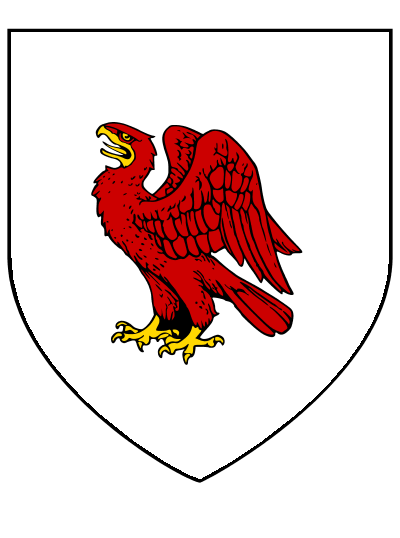 |
| Argent, an eagle rising gules, armed or. |
The other common posture is rising, often of falcons and other lesser raptors, sometimes of eagles. This is the one that tends to have the range of variant wing positions, such as:
- addorsed - wings back to back
- displayed - one wing either side of body
- elevated - wingtips up, usually used with one of the above
- inverted - wingtips down, usually used with one of the above
 |
| Ermine, a martlet volant vert |
Lastly among the ones common to multiple birds is volant, which means (for those of you whose French isn't equal to the task) flying.
Then we get on to the oddities:
- A peacock is almost invariably blazoned as in its pride, which is the obvious peacock pose with tail feathers displayed, close guardant.
- A crane is usually blazoned in its vigilance, which for some long-lost mythical reason means, wait for it, close, standing on one leg holding a rock in its upraised claw.
- Best of all, a pelican is legendarily supposed to feed its chicks on its own blood, and is blazoned either vulning itself or more often in its piety, both of which mean tearing at its breast with its beak.
As you've probably figured by now, birds in heraldry are plain strange!
Next up, fish. And heads. Roly poly fish heads!
Saturday, 19 January 2013
Heraldry 101, part 7 - an aside, and answers

It's a very nice little web app by the folks at Inkwell Ideas called Coat of Arms Design Studio - it requires Java, which may mean a little downloading, since the yawning great security hole in some recent versions has stopped Apple (among others) from enabling it by default.
Once you've got it working, the free version is pretty neat - you can place almost any kind of charge from its library on any background, and then export the results. The pay version adds the ability to import images, and a few extra tweaks.
If you think you've run across Inkwell Ideas before, yes, you have - I supported their Kickstarter for their Cityographer mapping product a while back.
Which just leaves the answers to last time: if you recall I asked you to identify three partial blazons and where they came from.
- Gules, three lions passant guardant in pale or, armed and langued azure. - is, of course, the Royal Arms of England
- Or, a lion rampant gules armed and langued azure... - is the lion on the arms of Scotland
- Gules, a bear erect argent, muzzled of the first, collared and chained or... - is the bear (without its ragged staff) from the arms of Warwick.
Saturday, 22 December 2012
Heraldry 101, part 6 - Lions, Tigers (well, almost) and Bears, oh my!
So. Welcome back to another instalment of the occasional series on heraldry. This time, as a follow on from the last article on charges in general, we'll move on to animals in general, and largely what would appear to be one of heraldry's favourite critters, the lion. Birds and fish we'll save for later!
We can divide the appearance of animals into two - the basic pose, and the head position. Most of these apply to any quadruped, but (with the inevitability of such things) some positions get a different name for specific critters. So... onwards, with the most common poses or attitudes:
With me so far? In addition to the above, there's affronté, which means 'facing the viewer', usually with front paws down as a cat might sit, and dormant (like couchant but with its head tucked in as if asleep). To add to the fun, salient is forcene for horses, climant for goats, and springing for deer. Also, there's erect (stop sniggering at the back) which means walking on two legs.
Note also that all these are facing left. Creatures facing right are said to be to sinister or contourné.
Cool. Now, the default head position for all these poses is with head facing in the same direction as the body. If the head is facing the viewer in any of the sideways-on poses, it's termed guardant. If it's facing backwards along the animal's spine as if looking over its shoulder, it's regardant (note, no 'u'!).
So, with that in mind? Your teaser for this week: figure out what the following blazons look like, and tell me which arms they are a part of. (The ones ending with an ellipsis are incomplete blazons, and they're all from somewhere in Britain.)
[1] Quite why there's a fascination with blue claws and tongues on heraldic lions I'm not entirely sure!
[2] I can't remember if I mentioned this earlier, but it's a heraldic affectation to refer to a previously mentioned colour (so in this case, 'of the first' means 'gules', 'of the third' would be 'or', etc.).
We can divide the appearance of animals into two - the basic pose, and the head position. Most of these apply to any quadruped, but (with the inevitability of such things) some positions get a different name for specific critters. So... onwards, with the most common poses or attitudes:
 |
| couchant |
 |
| passant |
 |
| rampant |
 |
| salient |
 |
| sejeant erect |
 |
| statant |
 |
| sejeant |
With me so far? In addition to the above, there's affronté, which means 'facing the viewer', usually with front paws down as a cat might sit, and dormant (like couchant but with its head tucked in as if asleep). To add to the fun, salient is forcene for horses, climant for goats, and springing for deer. Also, there's erect (stop sniggering at the back) which means walking on two legs.
Note also that all these are facing left. Creatures facing right are said to be to sinister or contourné.
Cool. Now, the default head position for all these poses is with head facing in the same direction as the body. If the head is facing the viewer in any of the sideways-on poses, it's termed guardant. If it's facing backwards along the animal's spine as if looking over its shoulder, it's regardant (note, no 'u'!).
So, with that in mind? Your teaser for this week: figure out what the following blazons look like, and tell me which arms they are a part of. (The ones ending with an ellipsis are incomplete blazons, and they're all from somewhere in Britain.)
- Gules, three lions passant guardant in pale or, armed and langued[1] azure.
- Or, a lion rampant gules armed and langued azure...
- Gules, a bear erect argent, muzzled of the first[2], collared and chained or...
[1] Quite why there's a fascination with blue claws and tongues on heraldic lions I'm not entirely sure!
[2] I can't remember if I mentioned this earlier, but it's a heraldic affectation to refer to a previously mentioned colour (so in this case, 'of the first' means 'gules', 'of the third' would be 'or', etc.).
Sunday, 30 September 2012
Heraldry 101, part 5 - charges, and arranging them
Now we have fields, divisions and ordinaries, we can move on to more interesting things: charges, and how they're arranged on a shield.
Here are a few example blazons with some of the more common charges.
 A five-pointed star is known as a mullet, so the blazon for this shield would be argent, a mullet gules.
If the star has a different number of points, it's blazoned as a mullet of N points.
 A circle is known as a roundel, so this shield would be described as argent, a roundel gules. Just to be awkward, there are exceptions to this, as there are to a number of heraldic charges. Specifically, in the case of a roundel or, it's more correctly blazoned as a beazant.
 Next up we have a sword, which is heraldically known as... a sword, surprisingly enough. So here we have vert, a sword argent. To be really specific, we have a sword argent, hilted or.
If we had the sword point down, it would be referred to as inverted.
As I noted in the section on the rule of tincture, secondary colourings, like hilts of swords etc, don't have to obey the rule.

This next one is a nod to the arms of France. The strange leafy thing is called a fleur-de-lys, and is a remarkably common heraldic charge.
Now, obviously, we can blazon this azure, three fleurs-de-lys or, but that doesn't tell us anything about how they're arranged. In this case, they're in a horizontal line... a fess, in fact. So we blazon this shield as azure, three fleurs-de-lys in fess or. Notice again how the colour adjective comes right at the end.
If they were arranged vertically, they would be in pale, and I'm sure you've already figured out the analogous terms in bend and in chevron.
 And here we have the humble arrow, in this case, sable, three arrows palewise in fess argent, barbed and fletched or.
Ok. It's a bit of a mouthful, but there's a couple of important things here. Note that we said palewise in fess. This means the individual arrows are palewise, or in other words pointing up and down like a pale, but as a group they are arranged in fess.

Conversely, this very similar shield would be sable, three arrows fesswise in pale argent, barbed and fletched or.
Like a sword, the arrow has its own terms for the secondary bits of colouring, as do many other charges. In many cases it should be obvious from the blazon, but here's an example of one that might not be, and our last, most complex blazon for this post.

So, here we have or, a rose gules slipped and leaved proper; on a chief azure, two roses argent.
Note that the main rose is blazoned as slipped and leaved, which means it has a stem and leaves. In this case they're blazoned proper but I could have got away with slipped and leaved vert.
The roses on the chief are ordinary heraldic white (Yorkshire) roses, and that's what you get if you just blazon a rose of any colour.
That's it for this post. Next up, animals. Predominantly lions, 'cause heralds are fond of lions!
Here are a few example blazons with some of the more common charges.

If the star has a different number of points, it's blazoned as a mullet of N points.
 A circle is known as a roundel, so this shield would be described as argent, a roundel gules. Just to be awkward, there are exceptions to this, as there are to a number of heraldic charges. Specifically, in the case of a roundel or, it's more correctly blazoned as a beazant.
 Next up we have a sword, which is heraldically known as... a sword, surprisingly enough. So here we have vert, a sword argent. To be really specific, we have a sword argent, hilted or.
If we had the sword point down, it would be referred to as inverted.
As I noted in the section on the rule of tincture, secondary colourings, like hilts of swords etc, don't have to obey the rule.

This next one is a nod to the arms of France. The strange leafy thing is called a fleur-de-lys, and is a remarkably common heraldic charge.
Now, obviously, we can blazon this azure, three fleurs-de-lys or, but that doesn't tell us anything about how they're arranged. In this case, they're in a horizontal line... a fess, in fact. So we blazon this shield as azure, three fleurs-de-lys in fess or. Notice again how the colour adjective comes right at the end.
If they were arranged vertically, they would be in pale, and I'm sure you've already figured out the analogous terms in bend and in chevron.

Ok. It's a bit of a mouthful, but there's a couple of important things here. Note that we said palewise in fess. This means the individual arrows are palewise, or in other words pointing up and down like a pale, but as a group they are arranged in fess.

Conversely, this very similar shield would be sable, three arrows fesswise in pale argent, barbed and fletched or.
Like a sword, the arrow has its own terms for the secondary bits of colouring, as do many other charges. In many cases it should be obvious from the blazon, but here's an example of one that might not be, and our last, most complex blazon for this post.

So, here we have or, a rose gules slipped and leaved proper; on a chief azure, two roses argent.
Note that the main rose is blazoned as slipped and leaved, which means it has a stem and leaves. In this case they're blazoned proper but I could have got away with slipped and leaved vert.
The roses on the chief are ordinary heraldic white (Yorkshire) roses, and that's what you get if you just blazon a rose of any colour.
That's it for this post. Next up, animals. Predominantly lions, 'cause heralds are fond of lions!
Sunday, 16 September 2012
Heraldry 101, part 4 - ordinaries, and the Rule of Tincture
A key thing to be aware of in part 3 is that everything described there is a division of the shield into two or more parts. What we're going to cover in this part are ordinaries, simple geometric shapes placed on the shield. A term often used to refer to the background colour of a portion of a shield is the field, and things placed on it are also termed charges, so we can speak of placing charges on a field.
The names of the most common ordinaries should actually already be familiar to you:
The first of these, then, would blazoned azure, a pale argent. And so on.
A couple of things to be aware of: first off, the distinction between per fess and a chief. Per fess is a division of the shield, a chief is a charge placed on it - the same is also true of per quarter vs a quarter. You'll also note that a chief occupies roughly the top third of the area of the shield, whereas a division per fess is much closer to halfway.
Secondly, I've deliberately left the various forms of cross out of this particular article, because the cross and its derivatives merit a post all to themselves. Also, many of these ordinaries have diminutive forms, or different names when there's more than one of them. I'll cover these too in a later post.
Finally, be aware once again that charges are placed on the field, rather than being divisions of it, and as such, a very important rule of heraldry applies, called the Rule of Tincture. This rule basically states:
Things to be aware of about the rule of tincture:
The names of the most common ordinaries should actually already be familiar to you:
 |
| Pale |
 |
| Fess |
 |
| Chevron |
 |
| Bend |
 |
| Chief |
 |
| Bend sinister |
 |
| Quarter |
A couple of things to be aware of: first off, the distinction between per fess and a chief. Per fess is a division of the shield, a chief is a charge placed on it - the same is also true of per quarter vs a quarter. You'll also note that a chief occupies roughly the top third of the area of the shield, whereas a division per fess is much closer to halfway.
Secondly, I've deliberately left the various forms of cross out of this particular article, because the cross and its derivatives merit a post all to themselves. Also, many of these ordinaries have diminutive forms, or different names when there's more than one of them. I'll cover these too in a later post.
Finally, be aware once again that charges are placed on the field, rather than being divisions of it, and as such, a very important rule of heraldry applies, called the Rule of Tincture. This rule basically states:
A colour may not be placed on a colour, nor a metal on a metal.Simple, really. But, as they say, honoured as much in the breach as in the observance. The rule of tincture first pops its head up in around the 14th century, and one may guess that it's a formalisation of earlier conventions, largely about picking contrasting colour combinations that were clearly visible at a distance.
Things to be aware of about the rule of tincture:
 |
| Arms of Geoffrey of Boulogne and Baldwin of Boulogne, King of Jerusalem. |
- it doesn't apply to furs or to things blazoned as proper. Technically, then, "or, a horse argent" breaks the rule, but "or, a white horse proper" does not!
- it doesn't apply to charges placed across divided fields, the details (claws, tongues) of things like lions etc, and marks of distinction or cadency (of which latter, more in several posts time).
- its application becomes more rigorous as one gets closer to the present.
One of the most famous breaches is that of the arms of the Crusader Kings of Jerusalem, blazoned as argent, a cross potent or between four crosslets or. One theory is that this was allowed to break the rule at the time, as it was a coat of arms of an exceptional holy and special nature.
Subscribe to:
Posts (Atom)
