Showing posts with label horses. Show all posts

Friday, 20 May 2016

Colour Concepts: 1 - Introduction

I seem to have been thinking a lot about colour, lately - what colour things are, and, almost as importantly, what colour things aren't. We have as human beings a lot of pre-conceived ideas as to what colour things are - ask a child, and they'll tell you water is blue, earth is brown, sand is yellow, etc - and a lot of these are actually quite startlingly wrong if you actually look at the thing in question. And a lot of those misconceptions we carry into adulthood.

So, with that in mind, it's past time we had another series on this blog, and so here's 'Colour Concepts', a series of ponderings on what colour things actually are.

As a free starter, which if you aren't a regular reader of this blog you can go catch up on, and if you are you should know already:

There's no such thing as a brown horse (well, actually, there is, but it's rarer than you think!). And white horses often aren't white

Friday, 15 March 2013

A horse of a different colour - blood bay

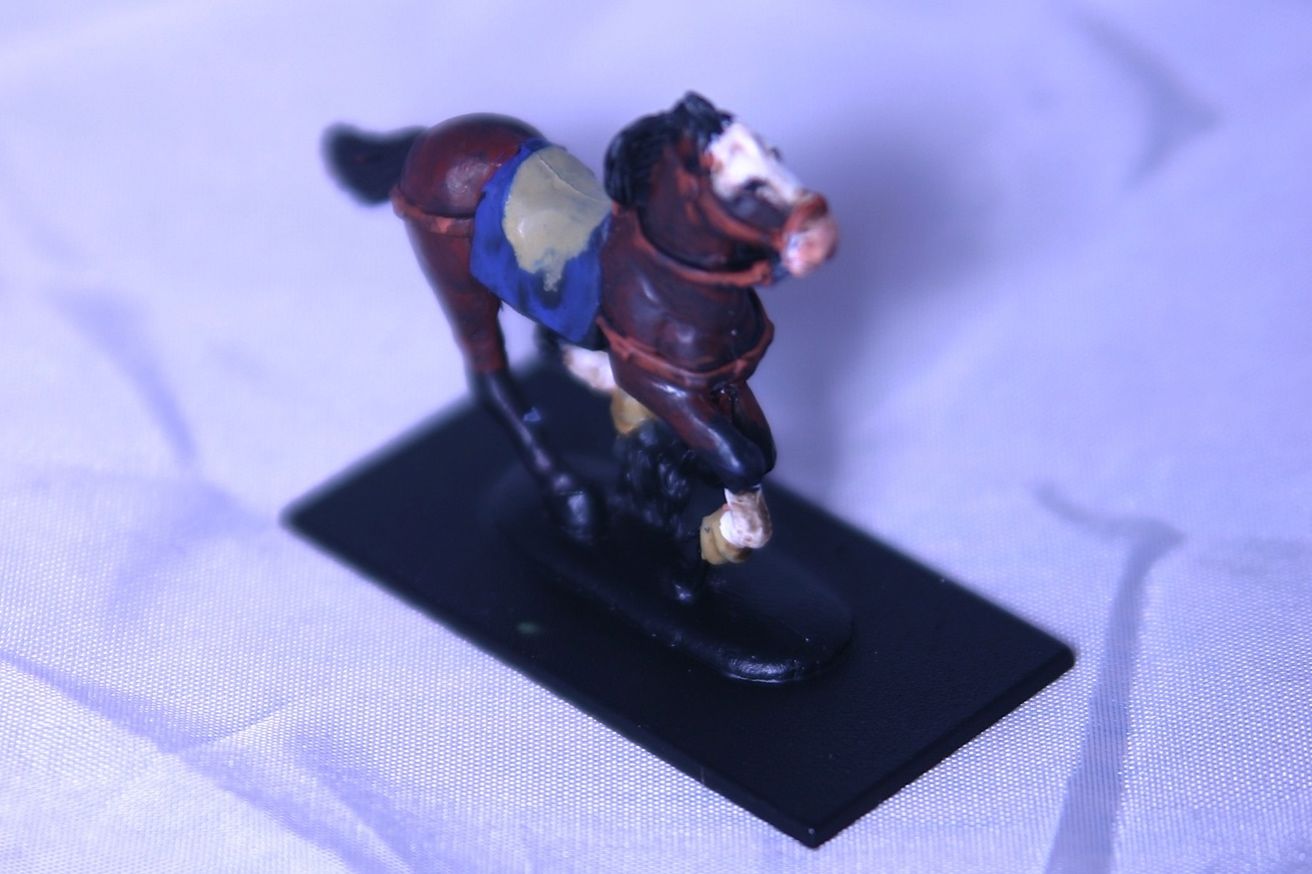
Sadly, the camera is more than a bit unforgiving with the flash and light tent, but here's a quick stage-by-stage.

First up, undercoat in black, and then undercoat those bits of the horse which are going to be white in AP Barbarian Flesh, the colour of the underlying skin. There's an argument that this isn't strictly necessary, since the AP White covers so well, but I find it focuses my thinking on what the horse is going to look at good and early, and you do need some flesh colouring.

Next, paint the areas of the horse that should be brown with a suitable shade - as I was going for a reddish bay, I used up some of my Citadel Dark Flesh, but in general, use a reference photo and mix a suitable shade. As its a bay, it should have a black mane, tail, muzzle and legs, so leave the mane and tail black and fade the brown where it meets the legs and muzzle.

Yeah. I missed a bit or two. But you
get the idea.
Next up, paint the white areas - I used AP Matt White, which covers brilliantly. The muzzle, if the white extends all the way to the mouth, will once again be skin coloured, but under white, that's flesh shade, so feather the white into the flesh tone.

The hooves of white-socked horses tend to be a shade of khaki, so I used Vallejo Khaki - if you're sticking to AP, a darkened Necrotic Flesh or Skeleton Bone should do the job.  

The saddle blanket is AP Crystal Blue (I think - it was a week ago!), and the saddle pad is Skeleton Bone (most of it is going to be hidden by the saddle moulded onto the rider, so I'm only suggesting it. Harness is Vallejo Red Leather, which I use largely because I never paint a horse that colour, so it'll always show up against the horse. 

If you can be bothered, drybrush the mane and tail with a very dark grey or brown.

Finally, the neat bit. AP Soft Tone ink wash on the white bits and khaki hooves, which will stop the colours being quite so stark as well as picking out the shadow detail, and AP Dark or Strong Tone (depending on the shade of brown you chose for the horse's coat) on the rest. And Bob's your uncle. In an ideal world, you probably want to see if you can find a slightly satin, rather than completely matt, varnish to finish the job.

And yes, I'm sure you can do better than me, but I hope you get the idea. If you're batch painting 72 of the little sods, the process, or something based on it, will get you a convincing looking (from any distance that matters for wargaming) bay horse in not that long. One tip - if you're batch painting, the maths works out roughly that you should pick out your hero horses that are going to be fancy colours, then split about a quarter of the rest off and earmark them for chestnuts, split a quarter of the leftovers from those off and earmark them as blacks, and paint the rest (which should be a bit over half) bay. The further back in history you go, the fewer chestnuts you'll probably have. I tend to work with a palette with a range of browns on it, everything from a reddish brown (GW Dark Flesh) through to an almost black brown, and will quite often do a bit of subtle mixing every few horses. But above all? Use a reference photo or two for colours, and vary them.

Saturday, 26 January 2013

A horse of a different colour... namely, grey plastic.

Twenty four Wargames Factory Persian horses, to be specific, ready to be coaxed into being some of what's looking like a rather large Parthian horde.

I am contractually obligated to give Curt first dibs on the photos once I'm done painting, but these should be the horses for the final part of the 'Horse of a different colour' series!

No, this is NOT the big announcement I was referring to.

Wednesday, 7 March 2012

A horse of a different colour part 9 - finally, we get to paint!

A batch of Saxon Duguth cavalry horses (largely from
Wargames Factory) ready undercoated. Assuming they
come out OK, expect some pictures next time!
So here we are, with what WAS going to be the last article in the 'A horse of a different colour' series, in which we finally get to apply some paint to miniatures. It would have been nice to have wrapped this series up with my 100th post (which this is!) but as usual, I seem to have too much to say for one post....

A note: as I said in the previous post, I'm not going into highlight/shadow colour detail here - if you're good enough, and have enough time, to use the Foundry three colour system or similar, you're good enough to work out what colours you need. In general, what I describe for a colour is somewhere between the main and highlight colour, since I'll be dipping or washing the end result.

So, onwards. And first, undercoat.

Tuesday, 6 March 2012

A horse of a different colour part 8 - "mostly bay"

So, if you remember from back around the end of January, we asked the question "what colour should the horses in my unit be?", and my second answer was "Mostly bay, unless there's a historical or other reason why not."

So, here we are with a cavalry unit, horses all assembled if necessary, and ready to paint, and that question comes up. Really, what follows is a series of followup questions.

Thursday, 26 January 2012

A horse of a different colour part 7 - breeding for colour

[Take 2 - Blogger's iPhone client very kindly lost the first take on this post for me on Sunday. Fortunately, it wasn't scheduled for posting till the day you're reading it, so all it required was me to remember what the heck I'd said. I'm sort of glad, since this version is better.]

Part the seventh. Now we've covered most of the saner genetic colour variations on a horse, it's time to consider some questions which are more related to wargames, specifically "what colour should the horses in my unit be?"

This has three answers, two of which cover 'colour' in the equine genetics sense, and one in the (non-equine) sense of paint (pots thereof). I think they're going to merit an article each to finish this off.

So, the first, short and glib answer to the question "what colour should the horses in my unit be?"

"Bay."

Yup. After all those interesting diversions into skewbald perlino dun roans, the predominant colour of your average, run of the mill cavalry horse is good old bay. Not 'brown'. Bay[1]. There are umpty-froo hundred breeds of horse (check Wikipedia if you don't believe me) but when it comes down to it, they're all genetically horses - equus ferus caballus. The three hundred plus different 'breeds'? They're mostly our fault, with a bit of randomness and mutations among closed populations thrown in.

While researching for this article, I ran across a fascinating piece (rejoicing in the same overall title as this series, in fact) that links to proof that ancient horses were pretty much bay, full stop. It also mentions in passing that chestnut horses only started appearing about 9000 years ago. What this tends to suggest is that ancient horses were pretty much universally AA EE, and that a (and similarly, one would guess, e, and most everything else) are simple random mutations that stuck. Sorry, you lovers of esoteric coat colours - your prize animal is a genetic fluke that managed to hang on!

There's a neat online tool that allows you to calculate what happens when two horses breed: it's pretty obvious that a pair of AA EE bays will always produce another, but equally if you breed Aa Ee with AA EE you will still always get a bay. It's not until you have two animals with e or a mating that you stand any chance of landing a black or a chestnut, and even then over half turn out bay.

And of course, here's where man comes in. Sooner or later, he or she decides, for example, that the black horse is somehow better, more sacred, whatever, and tries to breed from it. Not having the benefit of this series of articles, though, he's probably quite surprised when he breeds it with a bay, and only one in four of its issue turn out black. Eventually, though, he'll get a couple of blacks (EE aa or Ee aa) as a breeding pair, and hey presto, the majority of the progeny of a random pairing of those turn out to be black. But he'll be really surprised when he discovers that the small percentage that aren't are... chestnut??? Wait! What!?[2]

Next along comes someone with a white stallion. By which, of course, I mean a grey[3] horse."Wow," thinks our ancient horse farmer/herder/breeder. "Gotta get me one of those." So he or she pays for it to run with his herd for a bit, and, fingers crossed, it was genetically GG and presto, out pops a Gg foal. Which, to start with, won't look anything like its sire (recipe for disaster there if the white horse's owner can't explain that, although he will be 11 months[4] away by then!) but will eventually turn into a grey horse. Sadly, its offspring will only have a 25% chance of being grey. If our horse breeder's lucky enough to get two foals out of the original deal, that goes up to 75% if he interbreeds them.

And so it goes on! But, still, because your original wildtype horses were AA EE, and both of those are dominant, bays are going to be very common unless your population has been chosen, bred or otherwise lucked into possessing a high frequency of other dominant genes. For an example of this, check out the Appaloosa - actively and quite strictly bred for LP - and as more interesting cases, the Icelandic horse, which as a breed has enough of the recessive a gene for chestnut to be the most common colour, and the Haflinger, which all trace their lineage back to a single aa stallion. (Of course, that doesn't mean there'd be no horses looking like a Haflinger before then!)

This leads me to the second answer to the question "what colour should the horses in my unit be?":

"Mostly bay, unless there's a historical or other reason why not."

Join us next time for a few examples of that answer.

[1] If I have achieved nothing else in the course of this series, I shall be happy if my readers understand what a bay horse looks like.
[2] My second success of this series of posts will be if you can explain that to the poor confused breeder.
[3] My third goal from this series will be achieved if all my readers understand what a grey horse is.
[4] Way back when, on vacation with my soon to be wife, she'd spent the week trying very hard not to be a vet, and had a fun time playing the dumb blonde (for someone who's done a 6 year veterinary medicine course, that's not typecasting!), and getting the tour company rep to help her with all manner of things. Last night of the holidays, there's a quiz (of the "run up, sit in chair, answer, win a prize or pay a forfeit" type), and the rep, who has her pegged as a real ditz, asks 'what's the gestation period of a horse?'. Cue my dearest, still in apparent full-on blonde mode: she rushes up, hair flying, plonks herself down, answers, a bit breathlessly, "Eleven months." Slight pause, then she, almost without thinking, drops into her professional 'of course, this is a rough estimate I'm giving you' tone. "Give or take a couple of weeks."

Rep looks at her. Looks at his answer card. Looks at her. Very surprised. "How did you know that?" 

Herself, innocently, "I'm a vet."

I'm watching the rep's expression, and it's abundantly clear that he's in the process of going "She's a vet. That means she's intelligent. And I've been patronising her for a whole week..." and completely dumping a sizeable chunk of his worldview in the face of having made a bit of an ass of himself!

Sunday, 22 January 2012

A horse of a different colour part 6 - odds and sods

So, it looks like there will be a part seven of this series, and possibly even a part eight. However, first, here's part six, which is largely catching up on a couple of loose ends that I missed out on in earlier parts, and not the article I promised last time out.

First up, dappled greys.

I mentioned this very briefly in part two, but it merits a slightly longer note, since greys are pretty common (let's face it, if you have a British 1815 army, you need to paint some greys!).

Classic dappled grey
Wikipedia: Fabio Vidigal
CC BY-SA 2.5
Dapple grey is an intermediate stage, not seen on all horses, in the greying process, where the animal has a dark coat but with 'dapples', or dark rings with lighter centres, all over. It's an intermediate stage because, since grey is very analogous to the greying process in human hair (something I know about all too well), it won't last, and as the horse gets older it will tend towards overall grey or even white.

Much as it's tempting, and fun to paint, the odds are that even in a unit of grey horses, not all the horses will dappled.

Next up, the truth about the A gene, and seal brown horses.

Since I first started coding equine genetics online in the mid/late '90s, there's been some further research and discovery of aspects of the 'Agouti' gene, the A gene that determines the pattern of black pigment on horses. And just when you thought part one all made sense...

Seal brown horse
Wikipedia: public domain
There are, it transpires, multiple possible options for the A gene, as follows:
  • A+ - the original 'wildtype' A gene, dominant over everything, produces very restricted black pigmenting on mane, tail - seen in Przewalski's horse
  • A - the 'classic' bay as discussed in part one of this series, dominant over everything below it
  • At - less restricted black points, produces a 'seal brown' horse, dominant over...
  • a - no black points
So, our classic bay could be AA E, AAt  E or Aa E. The seal brown (i.e. AtAt E or Ata E), is visually and markedly different from either a bay or a black - it commonly has a dark brown coat, dark-to-black mane and tail, but touches of red around the eyes and muzzle, as well as parts of the underneath. In some parts of the world, this is called a 'black and tan'.

Tuesday, 10 January 2012

A horse of a different colour part 5 - '..."it is of an original colour," said Athos...'

...by which he meant yellow, and was referring to D'Artagnan's rather distinctively coloured horse, which is a source of much amusement in the early chapters of Dumas pére's "The Three Musketeers". So, today - yellow horses. Creams, palominos, buckskins, cremellos, and other things of that ilk.

Unlike the previous post, this is a case where we are much better off starting with a gene, the CR gene, also known as the cream gene. Also, this post is a good test of whether you've been paying attention. Once I tell you what the CR gene does, you can, pretty much, figure out what it will do in combination with other genes.

CR is, like some of the genes mentioned in the previous post, an incomplete dominant gene, in that CR/N has different effects to CR/CR, but those effects are pretty well understood, viz:
  • one copy of CR: all red pigment becomes gold, black is largely unaffected, light brown eyes
  • two copies of CR: cream coloured coat, rosy-pink skin, blue eyes
These tend to be written as CR and CRCR. Don't ask me why :D

A classic palomino.
Image from Wikipedia,
in public domain
So. Let's start with the easy one. Take a horse with aa ee CR. Now, ignoring the cream gene, that's a chestnut, as you should all be aware - remember, E means there's black in the coat, A means if there's black, its only on the mane, tail and legs. The presence of CR gets us a palomino: golden coat, flaxen mane, light brown eyes. Unmistakeable.
"For our young man had a steed which was the observed of all observers. It was a Bearn pony, from twelve to fourteen years old, yellow in his hide..." 
-- Alexandre Dumas, "The Three Musketeers", chapter 1
As an aside, while we're mentioning flaxen, the flaxen mane in ordinary chestnut horses is a single separate dominant gene, apparently.

A buckskin New Forest pony.
Image from Wikipedia,
in public domain
Right. Let's switch the ee for an Ee (or an EE, of course) and the aa for an Aa. Without the CR that's going to be a bay, with dark mane and tail. With the CR, obviously enough, it's going to have dark mane and tail but a golden coat: this is known as a buckskin. It's also potentially mistaken for a bay dun, just to complicate matters - the dun markings (the eel mark, particularly) do allow you to tell them apart.

If we don't have an A present, but still have an E, then the underlying horse will be black: the CR gene does affect this to a slight degree, producing what's known as a smoky black, which are, actually, quite hard to spot from an ordinary black or very dark bay unless you know what to look for, and certainly not at normal figure painting scales!

Right - let's move on to the double-dose of CR: this, as we've said, produces a cream coloured coat and blue eyes. So:
  • CRCR + chestnut is called a cremello,
  • CRCR + bay is called a perlino,
  • CRCR + black is called a smoky cream.
And they're all really difficult to tell apart! Perlinos may have a slightly reddish tail compared to a cremello, but in general - they're another 'almost-white' horse. 

I shall leave as an exercise for the reader to figure out what a horse with EE aa CRCR To/to would look like. Have a think, then have a peek at Wikipedia.

As ever, now we're down the weird and fun end of horse genetics, there are other genes which behave similarly to cream. The main one is champagne: it's a simple dominant gene, that lightens red/brown to gold, and black to chocolate. For more details, check Wikipedia, 'cause, frankly, we're also at the point where the number of possible permutations is starting to make my head spin, and my wife (who's a vet) is telling me I know more about horse genetics than she does, now!

And to answer the question from the previous article: Why do Romanies have black and white horses?

Well, thereby hangs a tale. On a trip to the Ironbridge Gorge Industrial Museum many years ago, my future wife got chatting to a chap (who may well have been a genuine Romany) sitting on the steps of a caravan and demonstrating various things,... well, being Anne, she was making more fuss of his horse, and owned up to being a vet. So, he asked her, seeing as how she was miss-well-educated-veterinary and all, if she could answer him that, with a twinkle in his eye. And, being miss-well-educated-veterinary, she racked her brains through a lot of what I've talked about in the last few posts, and after several good but wrong guesses, she was forced, to his gentle amusement, to give up.

And he smiled, and said, "Well, I'll tell you why we have black and white horses. To pull our caravans."

Next time? I'll wrap up, including some suggestions on painting groups of horses for (for example) barbarian tribes etc.

Tuesday, 27 December 2011

A horse of a different colour part 4 - coloured horses

Yes, it has been a long time, but here we are with part 4 of the horse genetics series, and here's where the fact that I'm an Englishman will be obvious.

We're going to discuss what over here are called 'coloured' horses - that is to say horses which have coats which are white with solid patches of another 'normal' coat colour. In the UK, black and white is called 'piebald', and brown/bay and white is 'skewbald' (bay and white - i.e. black mane/tail, brown patches on white - is sometimes called 'tricoloured'). Across the Atlantic, they're all called 'pinto'. However, this is a different pattern to Apaloosa horses (which are not unique to the US), and then there's the American Paint horse, which is another can of worms entirely.

The genetics of coloured horses is complex, and I'm not going to go into it in great depth. If you want a more detailed look, have a peek at the Wikipedia page on pintos. From a painting point of view, what really matters is the pattern of white - collectively, these genes are white-patterning genes.

Skewbald bay with classic
Tobiano markings.
Image by Jean-Pol GRANDMONT
CC-BY-2.5 
The main 'coloured' gene is Tobiano (To/to). It's a pretty normal dominant gene, so if your horse has one copy of it it will display coloured/pinto characteristics. The A/a and E/e genes (from article 1) will govern whether it's a black and white, brown and white or bay and white pinto/coloured. 'Classic' Tobiano markings are white legs, and vertical patches of white, with coloured chest, face and rump/withers.

Next up is Overo. This is somewhat complex, as there are several genes making it up, and we're in the realm of the American Paint breed, which means I need to tread carefully or I'll probably offend someone by getting it not 100% right or grossly over-simplifying.

Well, tough. 'Cause I'm going to over-simplify a bit. :D

Classic Overo pattern.
Image by www.horsevet.co.uk
CC-BY-SA-3.0
Overo patterning is different to Tobiano in that it's much more jagged and horizontal. It is a term used by the American Paint Horse Association to describe a number of 'coloured' horse patterns that aren't pinto/piebald/skewbald.

The most common genetic cause is the Frame gene (O/N). As you can guess from the fact that it's not uppercase/lowercase, its slightly different - it behaves like a dominant gene in that horses with one copy of O display the overo patterning in some form or other. Unfortunately, horses with two copies of O display Lethal White Syndrome - similar to the way Dominant White is lethal, except that the foal is born with a pure white coat and dies after about 72 hours due to an underdeveloped digestive system (and are usually put to sleep sooner).

[Edit: realised I'd missed an important one.]

Sabino patterning on a Clydesdale.
Note, this is not caused by SB1.
Public Domain photo.
Another relatively common (as these things go) patterning gene (or rather set of genes) is/are known as Sabino. They fall into the Overo category as far as the American Paint Horse Association is concerned, and the most common one, SB1/sb1, is another incomplete dominant gene, in that SB1/sb1 (i.e. one copy of the gene) has a different effect to SB1/SB1. Specifically, one copy produces irregular white patches on the face and extremities, and often 'belly spots'. Two copies, on the other hand, are yet another way of producing a white horse! Unlike both Dominant White and the Overo Lethal White, this isn't unpleasantly fatal, though.

Sabino-type patterning, however, doesn't always result from the SB1 gene - there are a number of similar patterned horses that don't test positive for the gene, so there's clearly more research to be done. It is a classic pattern in draft horses (Shire, Clydesdale) although whatever the gene is that causes it, it doesn't produce a white horse if the animal has two copies: it's also a pattern found in Arabian horses, again caused by yet another gene.

Appaloosa with one of
the many possible
patterns.
Wikipedia - CC-BY-SA-3.0
The Appaloosa is a whole different ball game - they display what's called 'leopard' spotting, a much more mottled pattern than either Tobiano or Overo. This is caused by a family of genes collectively giving rise to the 'Leopard complex'. The principal one is Lp/lp, which is an incomplete dominant gene, in that animals with one copy of Lp display different patterning to one with two copies of it. Generally, one copy of Lp produces more, larger spots than two.

I'm not going to try and describe all the possible spotting patterns here, but, as ever, Wikipedia will come to your rescue. It is worth noting that the Appaloosa patterns are not unique to the classic 'Indian pony' - there are records of horses with leopard spotting patterns from as far back as Ancient Greece.

As I said, by this article we're now in the realm of quite complex and not-perfectly-understood genetics - if you want to learn more, Wikipedia is the place to go. But otherwise, hopefully I've covered enough to allow you to get a paint-brush out and produce convincing coloured horses (as well as convincing-coloured horses!)

And I'll leave you with a question to see if you've been paying attention. Why do Romanies have black and white horses?

Saturday, 9 April 2011

A horse of a different colour part 3 - duns and roans

Time to deal with the genetics and colours of a couple of common horse colour variations. First up, duns.

Dun is what's known as a colour dilution gene - the D gene. 
  • D is dominant, and if present in a horse which is bay, black or chestnut lighten the base colour of the coat. Unlike the G/g grey gene this isn't 'going grey' - the horse's coat is lighter from birth, and it doesn't matter whether the horse has a DD or Dd pair.
  • d means you get the standard bay/chestnut/black colour as per normal.
The other key aspect of a dun horse is what are known as 'primitive markings'. These are, in order of most to least common/visible:
  • The 'eel stripe' - a black stripe along the centre of the back.
  • Leg stripes - often faint horizontal striping on the back of the (fore)legs
  • Shoulder stripes - much rarer
In addition, the face of a dun is often darker than the rest of its coat.

The three basic coat colours interact with DD or Dd as follows:
  • Bay (AA or Aa, EE or Ee) produces a bay dun or 'classic' dun with a light brown coat and darker main and tail, and primitive markings. 
  • Black (aa, EE or Ee) produces a "blue dun" or "grullo", with a grey coat and darker markings, points and often face.
  • Chestnut (aa, ee) produces a "red dun", with darker red points, markings and face.
A dun with the G (gray) gene will exhibit normal greying behaviour with age.

Roan, on the other hand, is not the product of a colour dilution gene, but it does produce an effect which can look similar at a distance. 
  • Rn (guess what, it's dominant) manifests itself as an even mix of white hairs and those of the original coat colour on the body, which (unlike a grey) does NOT lighten with age (and again, because it's a dominant trait, it doesn't matter whether your horse has an Rn/Rn or Rn/rn pair). Note that the head, mane, tail and lower legs remain dark.
  • rn means you get the standard bay/chestnut/black colour as per normal.
In a similar way to a dun, the three base horse colours produce named variants:
  • Bay + roan produces a bay roan 
  • Chestnut + roan produces a red roan, although the paler variants can be called a 'strawberry roan'
  • Black + roan produces a blue roan.
The key difference at the kind of scale we're likely to be painting figures at is that a dun has the 'dun face', the often darker colouring about the face, and the primitive markings, whereas the roan's head, mane, tail and lower legs remain dark. Another difference is that if a roan's coat is damaged (by, for example, a cut or a brand), it tends to grow back in the base colour without the white hairs.

So, that's duns and roans. Next, what are variously called 'paint' or 'coloured' horses.

Thursday, 7 April 2011

A horse of a different colour part 2 - specifically, white.

I'm going to cover two things in this post: first up, white markings.

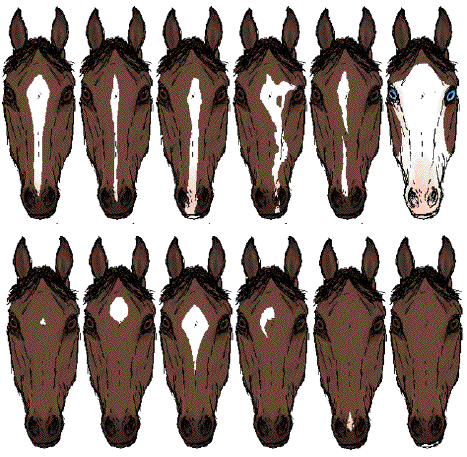
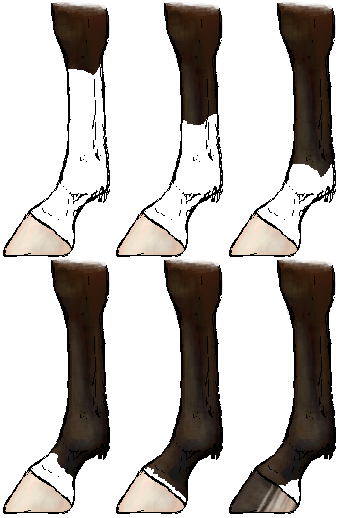
Many horses with a dark base coat colour (i.e. the ones we were talking about in the previous post) have white markings on the face, as well as one or more white 'socks'.

Facial markings range widely from almost none to the whole face - they're actually areas with different colour skin and hair pignment - note, for example, that when the white extends all the way to the nose, the underlying skin colour is pink, not dark.

Leg markings can extend as far as the knee, or as little as just above the hoof. Note that the hoof colour on a leg with white markings is going to be a shade ranging from flesh to pale khaki, not dark.

[Both images in the public domain, via Wikipedia's article on horse markings]

Ok. So that's white markings. What about white horses?

To begin with, a lot of the white horses you see aren't white. They're actually greys - even the famous Lipizaners (of "White Horses" fame, if you had the same schoolboy crush I did!) are grey, not white. Grey is produced by the grey gene, G or g.
  • G means the horse's coat will tend to go grey/white with age, much like a human's hair.
  • g means it won't.
Again, simples! Grey horses start out one of the principal colours as determined by their A/E genes, and as they age, they go greyer, until, eventually, they can end up white. The skin colour, however, remains dark (except under markings that were white at birth), so you can often tell whether a white horse is genetically a grey by looking at the shading round mouth and eyes, which will be dark. That is, if its mane and tail don't give it away by greying at a different rate to the coat, which can happen. 

A 'bloody shouldered' grey
Picture by Kumana @ Wild Equines
The grey colour goes through a stage of being a mix of dark and light hairs, leading to some interesting colours:
  • Various shades of grey
  • Dappled, where the intermixing of dark and light isn't uniform
  • 'Flea-bitten', where a red/brown base colour starts to re-emerge after the horse has become white, leading to a horse with a white coat with speckles of red throughout.
A rather spectacular variant of flea-bitten is known as 'bloody-shouldered', where the red is highly visible, usually on the shoulders.

There are a number of other genes that produce 'white' horses. One of the most common is the 'Dominant White' gene, W and w:
  • W is dominant, and produces a genuinely white from birth horse irrespective of the A and E genes - this can be distinguished by the skin around the mouth etc being pinkish, not dark. 
  • w doesn't - normal coat colouration genes take precedence.
Pure white horses are Ww, because the WW combination is fatal - an embryo with WW is reabsorbed and never goes to term.

There are other genes which can produce the appearance of white, but I'll cover those in a later article.

Next, duns and roans.

Tuesday, 5 April 2011

A horse of a different colour...

A brief diversion, brought on by a discussion over the weekend and at the club on Monday on the subject of painting cavalry.There is slightly more to the subject than slapping on some brown paint and hoping. My wife's a veterinary surgeon, and she would probably disown me for incorrectly painted horses!

A long time ago (somewhere about 1997) I used to play on one of the variants of an online MUD game that allowed players to code various things. This particular one was heavy on roleplaying as opposed to killing monsters, and one of the staff had coded up some rideable horses. These latter I showed to Anne, my wife, who was somewhat unimpressed at the way the code picked colours, so I set about learning more about horse coat colours and fixing the code.

So. Herewith part 1 of a course on horse colours. The easy bit. But first...

Basic genetics. It's all pretty simple, really. Most of the genes we're going to look at work much the same way, so let's consider a gene. In essence, it's a genetic switch between two characteristics, which we'll label as upper and lower case letters, say G and g. For a given gene, you have two copies - each of your parents gives you one chosen at random from the two they possess, so you potentially can either be GG, Gg (in one of two ways) or gg. [Yes, yes, spare me the gee-gee jokes!]

The important thing is that, in most of the cases we are considering, G is dominant - it swamps g - which means that if you have GG OR Gg, you will display the G characteristic, and ONLY if you have gg will you display the g characteristic.

With me so far? Good. So, how does this apply to horses?

There are TWO really important genes in horse colours. E or e, and A or a. Let's start with E.

  • E means the horse can produce black pigment in its coat - it has the potential to be a black horse.
  • e means it can't, it produces red/brown - it's a chestnut or sorrel.
Simples! So in the absence of any other genes, EE and Ee horses have some black in their coats, ee are chestnut. (And note that an EE horse can never produce a chestnut foal, because it must ALWAYS give a copy of E to its offspring, which will dominate whatever the other parent gives.) So, given random distribution of E and e, ONLY 25% of horses should be chestnut/sorrel.

And the rest? Well, that's where the other important gene comes in - A or a (it's called the Agouti gene).
Picture by extreme_eventer04
  • A means any black pigment in the horse's coat is restricted to its 'points' - ears, mane, tail, legs etc. i.e. if the horse has an it's a bay - red/brown body, black mane and tail. Recent research suggests that a horse with AA or Aa and EE is statistically likely to be a darker bay than one with Ee.
  • a means any black pigment will be everywhere: so IF the horse has an E it will be black
Again, A is dominant. So 75% of the remaining horses in our random selection will be bay (AA or two ways of getting Aa). The rest will be black.

So: ignoring the more complex colours and other genetic fun (I really went to town on the MUD code!), assuming a random gene pool, out of 16 horses, 4 will be chestnut, three will be black and the rest will be bays. 

(Aside: when I next paint some cavalry I'll add pictures of painted examples of each colour to these posts.)

Next time? White, both as markings and as grey/white horses.
Related Posts Plugin for WordPress, Blogger...