Thursday, 21 March 2013

Army Painter - Fireforge Mounted Sergeants

So as my last entry for Curt's contest on Tuesday, I thought I'd see just how good a job i could do going all out on the Army Painter way. You may have already seen this on Curt's blog - if not, enjoy!

Takeways from this:

  • the fact that AP now do paints that are 100% matches for their sprays makes the 'spray on the sprue' trick a major win
  • being able to use two different shades of ink (rather than dip) made this look much better
  • I still can't paint for toffee, but Army Painter lets me bluff well :D


4:30pm: start assembling the horses from a box of Fireforge mounted Sergeants (I already used three as command in my El Cid army, so there were 9 left)
5.05pm: Horse done. Blutak to painting stick, spray undercoat in AP Matt Black, leave to dry.
5.10pm: assemble first four riders
5.30 pm: pause to consider cloaks, realise I've put the heads on too soon. Swear, remove heads before glue sets. Stop assembling riders. Remove rest of bits of riders *except* cloaks from sprue. Spray cloaks AP Dragon Red *on the sprue*.
5.40 pm: Dad's Taxi Service to take son to tennis
6.10 pm: return from dropping James at tennis, assemble rest of riders sans heads
6.30 pm: blutac to painting stick, spray undercoat AP Daemonic Yellow - two coats about 2 mins apart.
6.40 pm: find spare kite shields without arms from left over Conquest Games Normans, satisfy myself I have nine between these and the non-heater shields in the Fireforge box. Spray backs AP Leather Brown, leave to dry while finding wife's pin box, spray fronts of shield AP Daemonic Yellow, again on the sprue.
6.50 pm: Paint shield designs with AP Dragon Red
7.05 pm: try sticking pins in heads. Discover they won't go in. Heat pin on gas ring, NOW they do. Arrange line of heads on pins on painting stick. Feel like a very angry Sheriff of Nottingham making an example of some miscreants. Wish I'd photographed it.
7.15 pm: Discover I'm out of AP Plate Mail spray. Swear. Spray heads with AP Human Flesh instead (and the can ONLY just lasts).
7.20 pm: brief moment of panic as I can't find glasses to drive to fetch James. Find them upstairs by dressmaking box. Pass wife (on way back from work) on garden path on way out to be Dad's Taxi again, whistle innocently (what me? steal pins?)
7.50pm: Return with son. Greet wife properly. Hide evidence. Supper.
8.20pm: Start painting horses. Three black, four bays of various shades (mixes of AP Oak Brown and GW Dark Flesh), one chestnut (GW Dark Flesh/AP Monster Brown mix, Vallejo Khaki mane and tail), one grey (AP Ash Grey using an AP stippling brush). A couple get white markings with AP Matt White and a touch of Vallejo Khaki on white-socked hooves)
8.50 pm: Start on horse blankets (AP Dragon Red, saddles/tack (Vallejo Red Leather - I pick this because I *never* use it as a horse colour, so my tack always stands out).
9.10 pm: brief pause to say goodnight to son.
9.30 pm: finish horse tack. Glue riders in saddles, start painting mail, axe head, swords, spearpoints on riders, mail coifs/helmets (AP Plate Mail). Re-glue the riders that don't stick first time.
9:55pm: start on spear hafts, axe handle, standard (Vallejo US Field Drab)
10.15pm: Start assembling cloaks/heads/shields. Retouch cloaks where needed with AP Dragon Red
10.30pm: Start basing: Tamiya Desert Sand textured paint and straight into a tub of Javis Desert Sand mix, knock excess off on sides of tub.
10.45pm: realise I forgot to do stirrup leathers and sword scabbards: Out with the Vallejo Red Leather again, being careful how I handle the bases!
10.55pm: Deep breath. Ink washes. AP Strong Tone first, on the mail, claks, standards and shields (just to back off the brightness of the yellow a bit). Then AP Soft Tone on the yellow surcoat.
11.15pm: mix 50/50 AP Matt White/AP Barbarian Flesh, try and retouch highlights on faces a bit.
11:20pm: AP Dark Tone ink wash on horses (except for the grey which gets AP Strong Tone.
11:27pm: poke head outside back door, realise it's close to zero outside. Decide varnishing is probably a bad idea :D
11:30pm: photograph, upload, start typing ... :D

So, that's nine figures to passable wargaming standard in 5 1/2 hours (ignoring two trips to the tennis club and a break for food). Setting aside the time for assembling (about 90 mins) that's four hours of painting, actually made easier by the fact they were plastic figures.

Wednesday, 20 March 2013

"We're GW. We don't have to care."

I was going to title this "GW shoot themselves in the foot again", 'till some more detailed research and thought reveals that, in fact, the above is more accurate.

And I quote:

"By way of illustration, but not limitation, North American Retailers are not permitted to sell GAMES WORKSHOP products on any website, web-portal, third-party web-portal or other Internet-based platform of any kind. This prohibition includes any form of online shopping cart that would enable a Consumer  to order or purchase GAMES WORKSHOP products on-line."

The referenced document goes on to give reasons, which boil down to 'we make more money this way'. If you go on and find GW's investor pages, you will find their one line business plan:
We make the best fantasy miniatures in the world and sell  them globally at a profit and we intend to do this forever.
If you're GW, it's kind of hard to argue against that, but you do start to wonder how many times they can piss off the people who aren't part of the Games Workshop Hobby before it'll all come crashing down. Sure, the Space Marine farce doesn't affect 40K and Fantasy players, nor does the whole 'we're just going to hang on to the Warhammer Historical properties and not countenance any offers to buy them' idiocy, because, after all, wargames is not the Games Workshop Hobby, so up yours.

This current one doesn't affect their core market - the people who buy stuff in GW stores - and I would assume that their belief is that the loss of those folks for whom the above is the last straw will be outweighed by those who just move to buying off a bricks and mortar store.

The key reason for this post, however: Wayland Games have asked that folks publicise their recent offer/statement on the subject, which I'm very happy to do.

Tuesday, 19 March 2013

Battle Report - 18-Mar-2013 - Chain of Command

Nearing the end of the pre-game - British and German
patrols on table 2 feeling each other out.
Last night the club had another visit from the Mighty Dux, Rich Clarke of Too Fat Lardies, this time to run us through a playtest/demo of their new WW2 "platoon plus" ruleset, Chain of Command.

If you want to know more about the core concepts in the rules, there are a couple of YouTube videos up here and here, with another one coming.

There's a couple of really innovative rules mechanics in the game that have the potential to really make the whole thing. First off, the patrol/jump-off point pre-game, which essentially eliminates the first bunch of moves in something like Bolt Action while the forces actually find each other.

The Germans on table one deploy to their jump-off
points.
In essence, both sides alternate moving patrol markers (usually four), within certain restrictions - they must be able to trace an unbroken chain within 12" through all their markers, and as soon as a marker gets within 12" of an enemy marker it becomes locked in place.

Once all of one side's markers are locked, the second phase of the pre-game is that the players have three jump-off point markers, which they take turns to place: they must be at least 6" further from the enemy than a patrol marker and they must be in cover.

The end result of this is both sides now have three points in cover to which they can deploy units (be they fire-teams or sections), and have both undergone some preliminary scouting out of the opposition. There's no end of potential for tactics and thought in the pre-game - I spotted several subtleties just in the one game I was helping referee.

The Germans on table 2 advance through
(one of my new) woods.
In the game proper, this is a TFL game that doesn't use cards. Instead it uses command dice - basically the player whose phase it is rolls 5d6: on any 1 he can activate a fire team, a 2 a section, a 3 a junior NCO, a 4 a senior NCO or officer. 5s add a pip to a 'Chain of Command dice' (when it reaches 6, there are potentials for special moves, including moving a jump-off point). 6s - if you roll zero or 1, the next phase is the other player's; two, it's yours again, three it's yours again and the turn ends (various effects like smoke, overwatch wear off), four its yours again, the turn ends and something random happens (air strike, mortar stonk...), and five (and I quote) you win a car :D

Activation works like you'd expect in any Lardies game: NCOs and officers get multiple command initiatives to activate sections or fire teams, rally off shock, etc.

Combat is very like Dux Britanniarum, believe it or not - you roll N dice to hit dependent on range, the target rolls to save hits, taking shock or kills depending on cover.

And that's pretty much it. The rules are still being fine-tuned, but all in all it's a great game, and I think it has potential to be a winner. I loved it (even if all I was doing was refereeing one of the two games): it really does require you to use period tactics and really think about your initial patrol and subsequent deployment, as if you don't then things can all too easily just bog down into a firefight.

Monday, 18 March 2013

Kickstarter Watch - Break Through

While browsing Kickstarter, I found Break Through - A card game of the Western Front 1914-18. It looks rather interesting:
This game is a challenging representation of the deadlock that existed on the Western Front from the end of 1914 to the spring of 1918.  By using a set of scenarios that limit which cards can be used, players are able to represent the difficulties facing commanders at specific times during the conflict.
[...]the designer, who is currently a visiting lecturer in games design at CRC in Cambridge and has taught previously in the secondary sector, believes there is an opportunity for a game of this nature as an effective (and simple to use) teaching tool.  The addition of the historical 'snippets' will hopefully encourage students to read and absorb the information and the 'gamification' has the potential to engage students[...]
It needs some more publicity, and more backers - only 4 after 5 days. As I said, though, it does look rather fun, and I'm considering a punt. Obviously, that's a pretty low-risk punt as it stands [!], but I'd kind of like to see it succeed, being a fan of nicely put together card games, so... if it interests you, especially if you're in education, I think it deserves to have the word spread. Maybe it's too late this time out, but...

Sunday, 17 March 2013

Book Review - The Crusades: The War For the Holy Land

Memory is escaping me where exactly I picked this up - I'm pretty sure it was given me by a friend - but The Crusades: The War for the Holy Land was my main read for my flight to and from Seattle last week.

The book is a very detailed, 800-page history of the Crusades: it's a tie in to a BBC series (not the Terry Jones one) which isn't, sadly, yet available on DVD. Thomas Asbridge knows his stuff, though, and more importantly he manages to tell it over the 800 pages and several centuries in a way that isn't in the least dry or dull. As I generally can't sleep on planes, books that keep me awake are a good thing, and I have to say I really enjoyed this and learned a lot from it. He does an excellent job of covering both the Crusader and Muslim sides of the conflict, presenting both sides' views on events wherever the historical sources let him, as well as providing insights into the character and motiviations of the principals on both sides.

In short? If you're at all interested in the period, it's a very good retelling of events in the Holy Land. It's also (for an 800-pager) remarkably cheap, and well worth a read.

Saturday, 16 March 2013

Google Reader to close

Well. phooey.
Like several other people who've commented on this, I am not a happy camper. At the last check, my list of feeds subscribed to in Reader was over 400: not just wargames blogs either.

I'm not impressed - any more than I was when Google took down Wave (and thus basically killed a RPG I'd being playing in for almost as long as Wave had been around. Hopefully the next thing on their list isn't Blogger.

I'll be exploring alternatives, and blogging my results here.

Friday, 15 March 2013

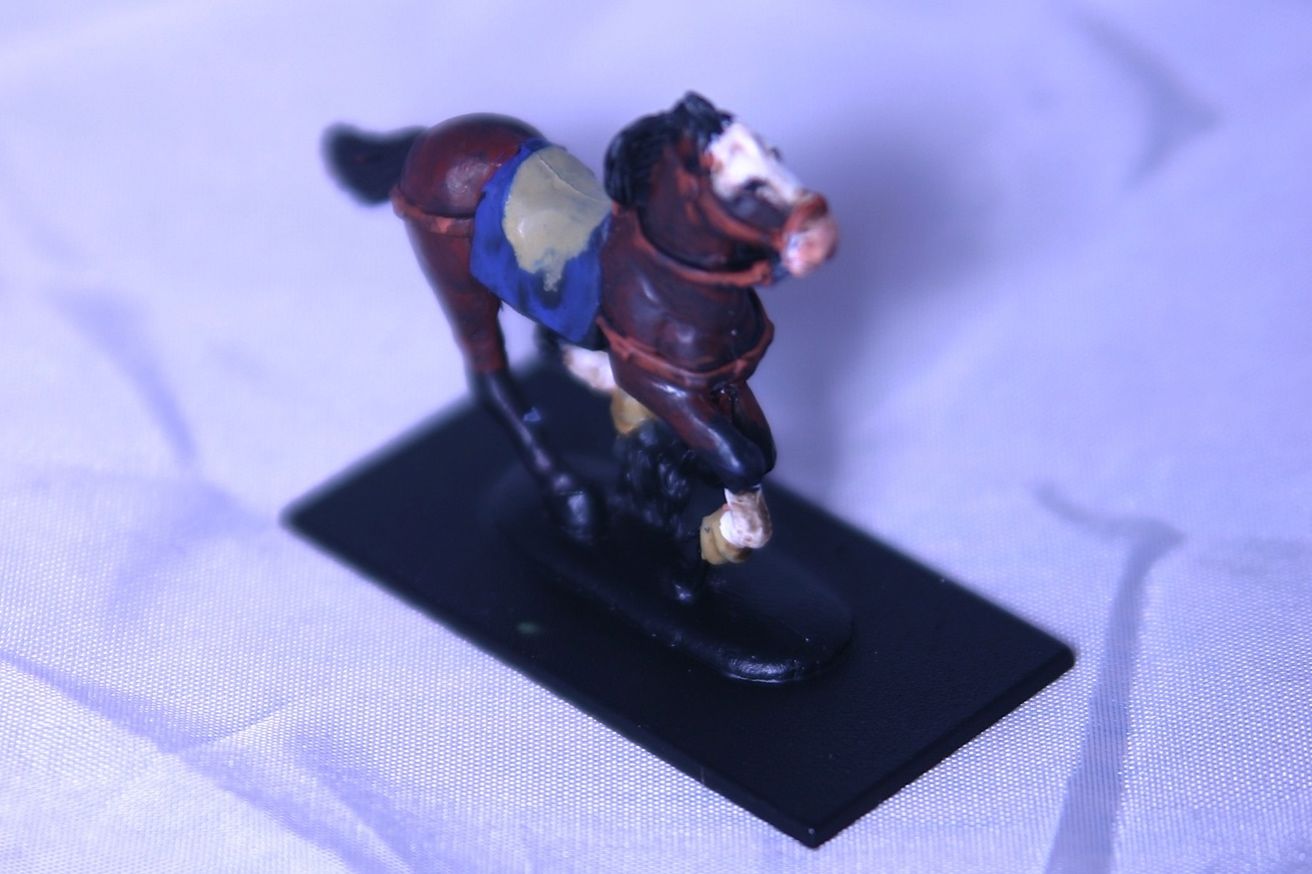
A horse of a different colour - blood bay

Sadly, the camera is more than a bit unforgiving with the flash and light tent, but here's a quick stage-by-stage.

First up, undercoat in black, and then undercoat those bits of the horse which are going to be white in AP Barbarian Flesh, the colour of the underlying skin. There's an argument that this isn't strictly necessary, since the AP White covers so well, but I find it focuses my thinking on what the horse is going to look at good and early, and you do need some flesh colouring.

Next, paint the areas of the horse that should be brown with a suitable shade - as I was going for a reddish bay, I used up some of my Citadel Dark Flesh, but in general, use a reference photo and mix a suitable shade. As its a bay, it should have a black mane, tail, muzzle and legs, so leave the mane and tail black and fade the brown where it meets the legs and muzzle.

Yeah. I missed a bit or two. But you
get the idea.
Next up, paint the white areas - I used AP Matt White, which covers brilliantly. The muzzle, if the white extends all the way to the mouth, will once again be skin coloured, but under white, that's flesh shade, so feather the white into the flesh tone.

The hooves of white-socked horses tend to be a shade of khaki, so I used Vallejo Khaki - if you're sticking to AP, a darkened Necrotic Flesh or Skeleton Bone should do the job.  

The saddle blanket is AP Crystal Blue (I think - it was a week ago!), and the saddle pad is Skeleton Bone (most of it is going to be hidden by the saddle moulded onto the rider, so I'm only suggesting it. Harness is Vallejo Red Leather, which I use largely because I never paint a horse that colour, so it'll always show up against the horse. 

If you can be bothered, drybrush the mane and tail with a very dark grey or brown.

Finally, the neat bit. AP Soft Tone ink wash on the white bits and khaki hooves, which will stop the colours being quite so stark as well as picking out the shadow detail, and AP Dark or Strong Tone (depending on the shade of brown you chose for the horse's coat) on the rest. And Bob's your uncle. In an ideal world, you probably want to see if you can find a slightly satin, rather than completely matt, varnish to finish the job.

And yes, I'm sure you can do better than me, but I hope you get the idea. If you're batch painting 72 of the little sods, the process, or something based on it, will get you a convincing looking (from any distance that matters for wargaming) bay horse in not that long. One tip - if you're batch painting, the maths works out roughly that you should pick out your hero horses that are going to be fancy colours, then split about a quarter of the rest off and earmark them for chestnuts, split a quarter of the leftovers from those off and earmark them as blacks, and paint the rest (which should be a bit over half) bay. The further back in history you go, the fewer chestnuts you'll probably have. I tend to work with a palette with a range of browns on it, everything from a reddish brown (GW Dark Flesh) through to an almost black brown, and will quite often do a bit of subtle mixing every few horses. But above all? Use a reference photo or two for colours, and vary them.
Related Posts Plugin for WordPress, Blogger...