Friday, 8 February 2013

Battle Report - 6 Feb 2013 - Principles of War

We had our first battle in Gav's second computer-moderated Penninsular War campaign this week. An entire French Corps under Maréchal Victor ran into a rather disorganised but larger force under Wellington just outside Palencia.

Battle lines drawn up, the French along the ridge line.
Unfortunately (or not, depending on how you look at it) the bunch of players for this one are dotted round the world (quite literally: one's in Australia and more than one in the US), so after a bit of negotiation it eventually fell to me and Gavin (it would have been Richard as well, but he had to cancel.)

We used Gavin's 6mm forces, and the Principles of War ruleset, which I've played a couple of times before, but am rather rusty with, so I was profoundly grateful that as rulesets go, they're pretty good at encouraging you to play period tactics.
Deploying short of the village pays off, as the British
advance gets rather logjammed round it.


As the British were (eventually) going to outnumber the French, I adopted a defensive position along a ridge line and the front edge of a relatively open forest. Basically I had one brigade in reserve from each division, plus a full division in reserve. There was a small village just in front of that line, but after a little consideration I left it as an obstacle for the British, rather than bend my line.

The British turned up somewhat piecemeal, rather hampered by a) Gavin's awful dice rolling for command points for the commanders that mattered and b) Wellington having to command a massive group of several otherwise leaderless stragglers, which meant he was never going to have enough command points.
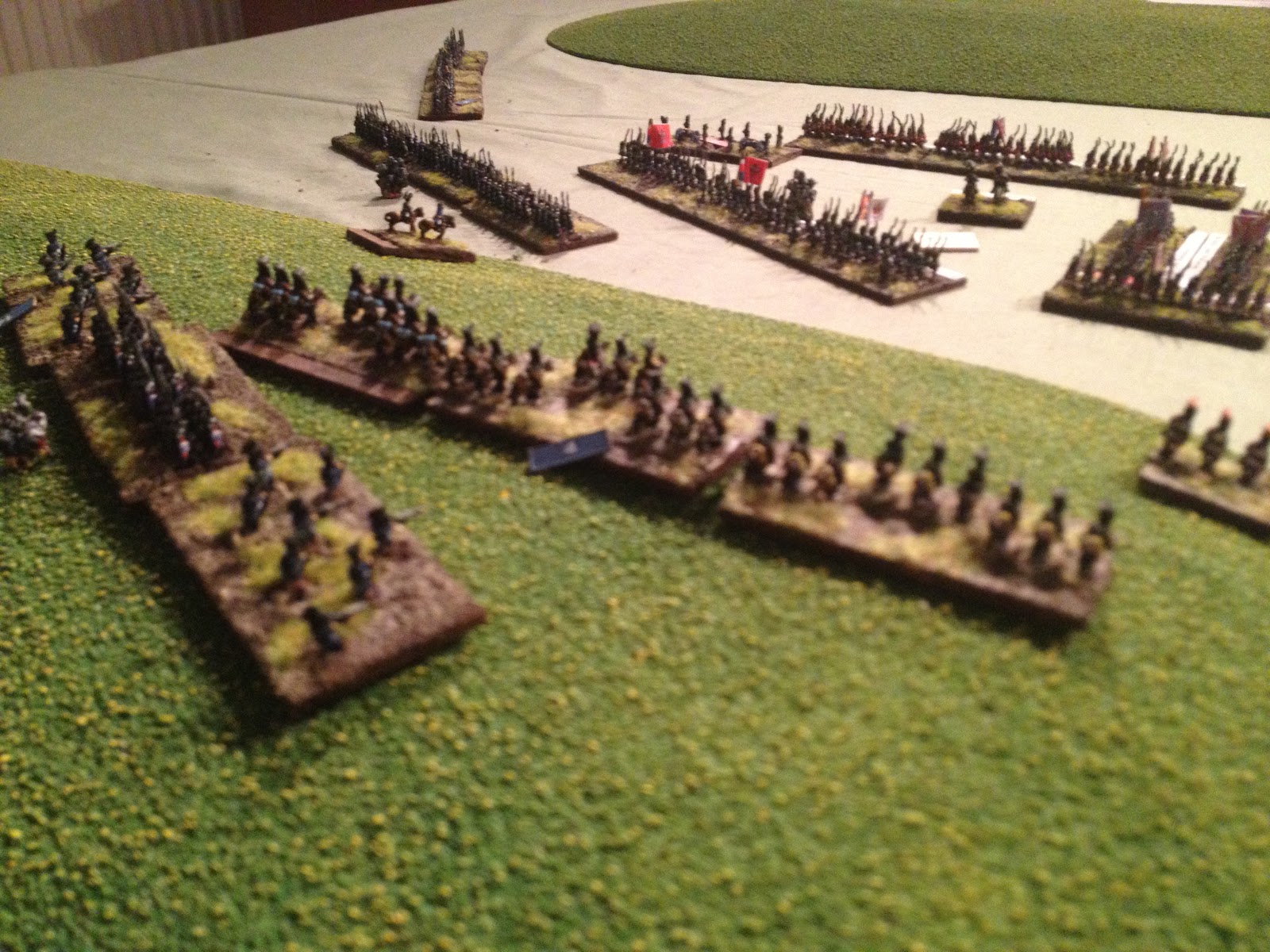
Villatte's Division engages the British.
My deployment seemed to work quite well: on the right, the British got rather snarled up round the village, taking odd retreat results from speculative artillery fire, and generally being short on command points.

On the left, I advanced some of Victor's cavalry to force the British division (with no cavalry to support it) into square, and had Victor change that flank's orders to engage, in the hope I could shift them before the considerable column of reinforcements (nearly two divisions worth) arrived. It nearly worked. Had my dice rolls not decided to desert me at the crucial moment, I'd have driven off at least one if not two brigades.

The British make a renewed attempt to force an attack
through the village onto Ruffin and Lapisse's Divisions.
On the right, a couple of British units got within canister range, and veered off pretty sharply, which did nothing at all to help the snarl up in the village.

In the centre, Crawfurd and the Light Division (or at least, elements thereof) were doing better than the rest (helped by Crawfurd not having much to command). However, they did get on the receiving end of several turns of artillery fire from Victor's horse and foot artillery, and were starting to look pretty shaky, not helped by Crawfurd himself getting hit.

The British, having fallen back from the French
counterattack. Crawfurd's brigade is on the extreme right.
By now I'd lost a couple of units on both flanks, and was quietly very glad I'd kept brigades in reserve to plug holes. Villatte on the left had managed to force the British back, but not as successfully as I'd like, despite Beaumont's Hussar's charging in on a British regiment.

And there, or thereabouts, is where we left it, with about a turn and a half to go before nightfall (it was gone 11:15pm). As the remaining turns don't need much strategic input from me, Gavin will run them over the weekend. It's still a bit touch and go, IMO, although I get the impression a fair few of the British units are low on morale. The main worry is Spencer's entire division of infantry heading for the French centre, but I think nightfall may beat them.


The one problem I have with Principles of War, once I've got used to the odd turn sequence (effectively Morale, Firing, Melée, Move), is that I find the morale roll (d20 vs unit strength + mods) slightly more prone to extreme results than I'd like. I wonder if 3d6 would be a better roll? Maybe that's one for the Probability For Wargamers series? :D


Thursday, 7 February 2013

The Linnius Campaign

To satisfy my inner detail-obsessed pedant, I've added a page to this blog with a timeline of the current Dux Britanniarum campaign that Andy and I are running, which I hope to keep up to date as we go.

Not 100% sure I have Andy's side of the campaign finances quite straight, but I'm pretty sure mine are. Aelfric actually has enough on hand to fight a battle and even hire some mercenaries to help out, so this coming Monday has the potential to be fun!

Wednesday, 6 February 2013

Another reason to love Games Workshop

They've hit a small self-published author with a takedown notice for use of the term "space marine" in e-books.

I'll quote a bit from her blog:
In mid-December, Games Workshop told Amazon that I’d infringed on the trademark they’ve claimed for the term “space marine” by titling my original fiction novel Spots the Space Marine. In response, Amazon blocked the e-book from sale [original post and update]. Since then, I’ve been in discussion with Games Workshop, and following their responses, with several lawyers. 
To engage a lawyer to defend me from this spurious claim would cost more money than I have, certainly more than the book has ever earned me. Rather than earning money for my family, I’d be taking money from them, when previously my writing income paid for my daughter’s schooling. And I’d have to use the little time I have to write novels to fight a protracted legal battle instead.
In their last email to me, Games Workshop stated that they believe that their recent entrée into the e-book market gives them the common law trademark for the term “space marine” in all formats. If they choose to proceed on that belief, science fiction will lose a term that’s been a part of its canon since its inception. Space marines were around long before Games Workshop. But if GW has their way, in the future, no one will be able to use the term “space marine” without it referring to the space marines of the Warhammer 40K universe.
I am (as I've previously said) not a fan of Games Workshop. This, however, takes the cake: I note with ironic amusement one of their upcoming titles is 'The Death of Integrity". No comment needed.

I find it, like the original author, very difficult to believe that GW invented the term 'Space Marine' any more than Lucasfilm/TSR had a right to the term 'Nazi': in fact, I've set some of my friends who are deeply steeped in Science Fiction lore and history to see just how far back they can go in a search for uses of the term.

Spread the signal.

[Note: John Scalzi has picked up on this, as has Patrick Nielsen Hayden.]

Tuesday, 5 February 2013

Heraldry 101, part 8 - strictly for the birds

If you remember, back in part 6 we covered the basic postures for quadrupeds, with specific reference to that favourite of heralds, the lion.

I did comment at the time that birds and fishes are a whole different kettle of... erm... birds and fish, and that I'd dedicate another post to them, or at least the commonly-used ones. Unfortunately, it turns out that birds are nearly as complicated as quadrupeds, so we'll just do birds this time out, OK? Note, I'm also going to start blazoning my examples, just to keep you on your toes.
Sable, an eagle
displayed or.

There are a few special cases which I'll cover at the end, but birds' postures are one of a few general variants, along with assorted changes in wing position. First up is displayed, which is wings and legs splayed. This is pretty much reserved for the heraldic eagle, and seen on lots of imperial German arms.

Azure, six martlets close
in pile or.
The next most common is close, which is the classic sideways on, wings furled pose that most non-raptors are drawn in. The English cricket fans among you may recognise the arms on the left as those of Sussex, and you might also note that the bird has no feet! This is the rather odd heraldic bird, the martlet, which for reasons lost in the mists of time has... no feet.

Owls are almost always depicted as close guardant (sometimes close affronté), in which guardant has exactly the same meaning as with quadrupeds: looking at the viewer.
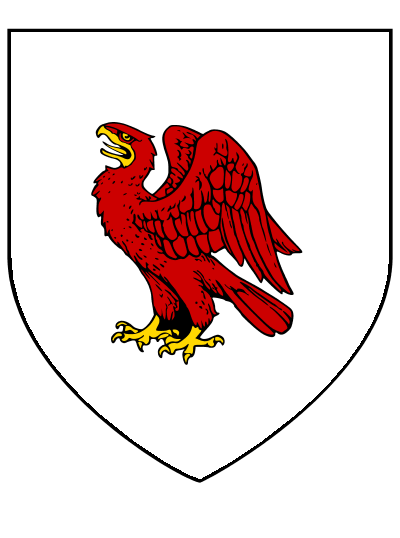
Argent, an eagle rising
gules, armed or.

The other common posture is rising, often of falcons and other lesser raptors, sometimes of eagles. This is the one that tends to have the range of variant wing positions, such as:

  • addorsed - wings back to back
  • displayed - one wing either side of body
  • elevated - wingtips up, usually used with one of the above
  • inverted - wingtips down, usually used with one of the above
Ermine, a martlet
volant vert
Lastly among the ones common to multiple birds is volant, which means (for those of you whose French isn't equal to the task) flying.

Then we get on to the oddities:
  • A peacock is almost invariably blazoned as in its pride, which is the obvious peacock pose with tail feathers displayed, close guardant.
  • A crane is usually blazoned in its vigilance, which for some long-lost mythical reason means, wait for it, close, standing on one leg holding a rock in its upraised claw. 
  • Best of all, a pelican is legendarily supposed to feed its chicks on its own blood, and is blazoned either vulning itself or more often in its piety, both of which mean tearing at its breast with its beak. 
As you've probably figured by now, birds in heraldry are plain strange!

Next up, fish. And heads. Roly poly fish heads!

Monday, 4 February 2013

Hammerhead 2013 final play test

As I mentioned in a previous post, the club are taking another of our warped, fun, cheap-as-chips participation games to Hammerhead this coming Sunday.

Without further ado, then, here are some teaser photos. :)


Sunday, 3 February 2013

Terrain part 3 - Man and the landscape

Over the weekend I've been travelling a fair few times between Peterborough and Grantham, over what is part of the countryside that Andy and my Dux Britanniarum campaign is set in. Basically we've been driving up from Durobrivae to a point just south and west of Cavsennae (if you have the map from page 79 of the rules). Now obviously, it's 2013, and the landscape shows a lot of signs of the hand of man, but even if you take away the glaringly obvious ones, the railway, the motorway, the telegraph poles, the electricity pylons, you're still left with a lot. And remember, when you do that, you also have to take away a fair number of the land level changes that things like railway embankments and road grading create.

If you can let your inner mental editor do that, and maybe remove anything that looks like it was built this or last century, then maybe, just maybe, you're kind of close to a Napoleonic era England, or a landscape for a War of the Worlds campaign (hey… there's an idea!). But there's still so much of what you're seeing that looks quintessentially English and somehow 'natural', but that plain isn't.


Take a look at the image on the right, which is a Google Street View from just south of what's now Ancaster but was probably Cavsennae in Saxon times. 
Ok, so we can easily mentally edit out that big radio tower and the few structures. But there's also those awfully English-looking hedge lines. Those didn't happen by accident. Not only that, some of them are old enough to be interesting.

The lovely Chantelle is a friend of mine who (as well as being part of the fabulous Talis Kimberley's band - check her out!), very usefully both happens to be a professional archaeologist and someone who was at the con I was at this weekend, so I picked her brain a little, and probably will do so more before I'm done (she's promised to go trawl through some of her lecture notes for me). To broadly summarise, a lot of the field patterns we see are quite late in nature, but it would be naive to assume that what we'd be fighting over for a Dark Ages game was devoid of field boundaries and similar man-made intrusions on the landscape.

I suspect this is going to turn into another series of posts, and I probably ought to state here and now that anyone who thinks wargaming is just playing with toy soldiers has clearly not been reading my blog lately! I now find myself doing research into Dark Ages and Romano-British farming techniques purely so I can build scenery and craft more detailed terrain rules to satisfy my inner pedant.

Google Earth view of lynchets at Kirmond Le Mire
in Lincolnshire. [This is actually in prime country for
Andy and my campaign.]
My tame expert mentioned lynchets as a not-unusual feature, so of course I had to look them up. It turns out a lynchet, or set of lynchets, is what you get if you repeatedly plough a slope. Essentially what happens over time is that the ploughed material falls downslope - there's a debate afoot as to whether the terraced effect you get is encouraged by the farmer building a wall or such, or just happens, but they're pretty distinctive, and you get them many places in the UK where there are slopes to be farmed.

And I have to say? I'd love to see someone plonk a lynchetted hill tile on a wargames table!

More soon, I suspect. But to close? Today I learned a new word. No day on which you learn a new word is entirely wasted :D Thanks, Chantelle!

[Edited to add: Ashley in comments recommends Making of the English Landscape. Duly ordered, along with Francis Pryor's book of very nearly the same title (he does admit it's a rewrite/update!)]

Saturday, 2 February 2013

Probability for wargamers 8 - +1 vs reroll

It's one of the rule-writers' common ways of making weapons in Warhammer-like d6 systems different. Some weapons get +1 to hit, some get a reroll. Which is better though?

Interesting question, and with the amount of stuff we've worked out in previous posts, not that hard.

With a target number of four, for example:

  • Your normal odds are 3 in 6, or 50%.
  • With a +1, obviously, they become 4 in 6, or 66.7%.
  • For the reroll, you have a 50% chance of succeeding on the first attempt, plus odds of (chance to miss * chance to hit a second time), i.e. 50% + (50% of 50%). Which makes 75%. Clearly the reroll's the better bet. 

I won't work out the details for other target numbers: here's the table:

Normal
+1 to hit
Re-roll misses
3
66.67%
83.33%
88.89%
4
50.00%
66.67%
75.00%
5
33.33%
50.00%
55.56%
6
16.67%
33.33%
30.56%

OK, so it looks like the re-roll's a better bet unless your target is hard to hit.

Another favourite of designers is the '+1 strength' modifier on the wound roll. Let's look at that: typically, for WAB, equal STR means wounding on a 4. 

Hit+Wound (normal)
Hit+Wound (norm/+1STR)
Hit+Wound (reroll)
3
33.33%
44.44%
44.44%
4
25.00%
33.33%
37.50%
5
16.67%
22.22%
27.78%
6
8.33%
11.11%
15.28%

Again, interesting, The re-roll's still better, but less so. 

Moral of the story? Given the choice? Take the weapon that gives the re-roll!


Related Posts Plugin for WordPress, Blogger...